

Customer-service AI chatbot

AI chatbot for customer service, with human handover

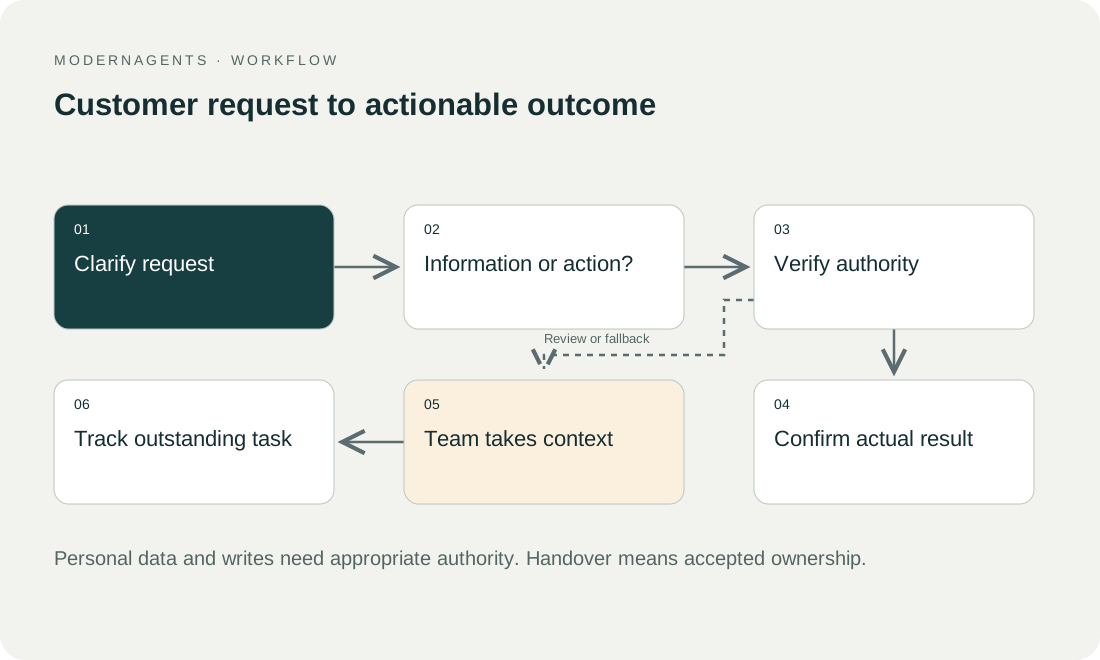
We help businesses across Europe choose a bounded customer-service task and assess existing helpdesk features first. English can be the project language while customer conversations use separately tested languages. Where extra implementation is useful, we connect approved knowledge, allowed actions and a traceable handover. A proposed answer is kept distinct from a confirmed action in your systems.

See the proposed workflow →

30 minutes, no obligation, German or English. Start with common questions and the team that handles exceptions. Clicking loads Cal.com (USA); the call runs on Google Meet. Prefer to write first? Ask by email. We send the draft data processing agreement and our terms on request.

Understand
Identify the request, available sources and whether the task needs identity verification.How it works · step 1/3
Resolve
Answer within approved scope or perform an explicitly permitted action with destination confirmation.How it works · step 2/3
Transfer
Give unresolved cases an owner, useful context and an honest next step.How it works · step 3/3

In short

We help businesses across Europe choose a bounded customer-service task and assess existing helpdesk features first. Where extra implementation is useful, we connect approved knowledge, allowed actions and a traceable handover. Start with a few repeatable tasks. The written offer and terms govern scope, credit and any refund.

From real engagements

Marcus Markowitsch

Marcus Markowitsch · CEO, go-models.com

“People applying as models often have questions about the process. An AI phone assistant now guides applicants through the application step by step. The applications themselves are still reviewed by our scouting team.”
Read the case study →

A useful scope

Plan the outcome after the chat

Start with a few repeatable tasks. General questions, personal records and actions have different requirements. A website answer, a saved support case and an executed order change are separate outcomes.

Existing support software first

Check help-centre search, licensed AI features and human handover in the current platform. A clearer FAQ or enabled product feature may be sufficient; custom integration must resolve a specific gap.

  • Approved and current knowledge

    Define which service descriptions, opening hours and rules may be used. Assign source owners and an update route. Test conflicting or missing information instead of assuming a source link guarantees a correct answer.

  • Identity before personal details

    Order and appointment information needs the agreed verification route. A reference number by itself does not establish that the person asking may see or change the record.

  • Actions with explicit boundaries

    Specify allowed writes, approvals and success confirmation. Refunds, discounts or changed appointments must not be presented as completed merely because the model generated a message.

  • Handover that reaches somebody

    Agree triggers, recipient, context and availability. If staff or the ticket system is unavailable, use a defined alternative without inventing an immediate connection or a response-time promise.

  • Website and WhatsApp assessed separately

    Each channel needs its own supported account, integration and operating rules. Website chat working in a demo does not establish that WhatsApp or every CRM is connected.

Customer data and responsibility

Make the boundaries visible

Identify the assistant as AI and make a human route available. Assess the actual content, data route and applicable obligations for the deployment; a chatbot label or EU-hosted component is not a complete privacy assessment.

Clear introduction
Design an explicit AI introduction and test it in the actual channel. The dated AI Act guide explains relevant role and transparency questions; example wording is not universal legal approval.
Minimum necessary information
Define which customer details a task needs. Avoid requesting payment credentials or unrelated sensitive information. Specify what a handover summary may contain and who may receive it.
Processing and retention
Document providers, locations, access, model settings and retention for conversations and logs. Agree processing terms and the relevant information route before real customer data is introduced.
Changes remain controlled
Assign owners for sources, actions and escalation rules. Repeat relevant tests after changes and retain a way to stop automated actions while preserving a usable contact route.

How it starts

One service task, with an acceptance decision

  1. Intro call

    Free

    Review common questions, existing support tools and three cases that must stay with staff. Define the likely source and destination.

  2. Trial run

    from €2,500 · credited towards implementation

    Agree the questions, allowed actions and handover tests. Assess actual outputs and remaining work. The written offer and terms govern scope, credit and any refund.

  3. Implementation and care

    Scoped fixed fee · care agreed separately

    Implement the agreed channels and supported connections. Assign content updates, incident handling and retesting. Separate platform usage, integration work and ongoing support in the proposal.

The implementation of one contained workflow costs about €3,000 to €5,000. Projects with several processes and systems cost more, and the fixed fee is in your proposal before work starts. Ongoing care starts at €250 per month per workflow. 30 min · remote · no obligation. And if AI isn't the right tool, we'll say so.

Practical questions

Before a chatbot speaks for your business

01Can you guarantee it never invents an answer?

No model-based system should be accepted on that promise. We define allowed sources, test missing and conflicting information, and provide a review or handover route. Accuracy must be assessed on the actual task.

02Can customers always speak to a person immediately?

Only if your staffed service actually supports that. Otherwise the bot should offer a callback, ticket or another agreed route and explain its real availability.

03Does the bot need access to all customer records?

No. Access should match the permitted task and verified identity. General information may need no personal record access at all.

04Can it issue refunds or change orders?

Only as part of an explicitly permitted, verified and tested action flow. Information-only or request-intake deployments do not gain those permissions automatically.

05What does a successful trial measure?

Correct answers, confirmed actions, useful handovers, repeat contacts and remaining staff effort. Closing a chat window is not proof that the customer's problem was resolved.

06What changes when a chatbot serves several European markets?

Service rules, customer language, contact routes, currencies, opening hours and data-protection context must fit each market. A translated answer must not apply one country’s returns policy or operating promise to another. Test the intended markets explicitly, including the UK where relevant. The implementation of one contained workflow costs about €3,000 to €5,000. Projects with several processes and systems cost more, and the fixed fee is in your proposal before work starts. Ongoing care starts at €250 per month per workflow. Read the article with the cost examples. Calculate with your own numbers.

Service and project scope

Who is it for?

For businesses with frequent, bounded customer questions and an available service channel for exceptions. Enquiry types and answer maintenance matter more than company size.

Use this outline for the introductory call. The individual proposal and agreed acceptance criteria define the commitment.

Robert Van Ysendyck

Robert Van YsendyckFounder & Managing Director

Bring a few examples and one difficult exception. We can then assess a useful scope and the handover your team can actually support.