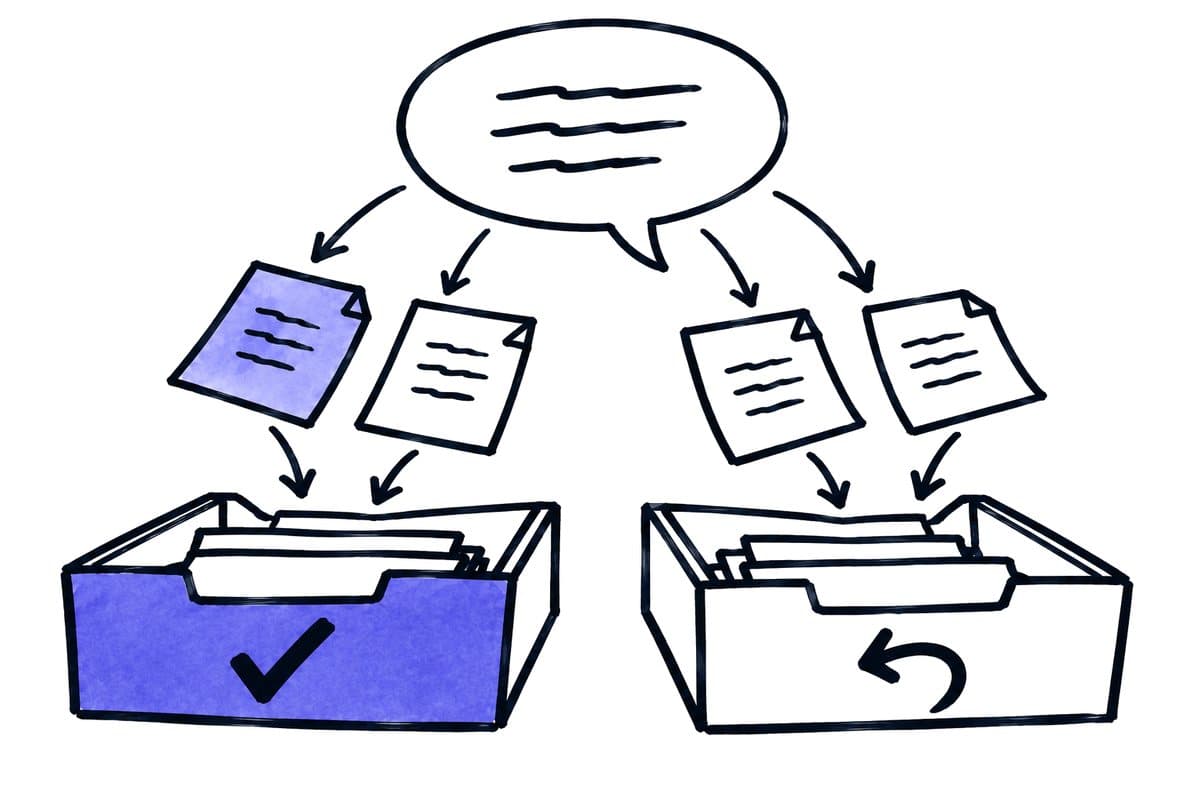
Plan languages by task: public information, personal order status, clarification or staff handover. What matters is which tasks can reliably reach completion in each language. The number of languages advertised by a platform does not establish that capability.
Key takeaways
The main points for a multilingual customer-service chatbot are:
- The language of a message indicates a communication preference; it does not prove residence, contract country, delivery destination or permission to access an account.
- Keep three values separate: preferred conversation language, relevant market or shop and, when needed, the authenticated customer account.
- Automatic translation can produce a draft; it cannot approve the underlying business statement.
- Compare completion and repeat-contact rates by language, market and request type.
01 / 09
Why separate language, market and customer identity?
Language is a preference. The language of a message indicates a communication preference. It does not prove residence, contract country, delivery destination or permission to access an account. A customer in Vienna may write in English, while a German-speaking customer may have purchased from the Swiss store. Dialect should not determine binding country rules.
Three values. Keep three values separate: preferred conversation language, relevant market or shop and, when needed, the authenticated customer account. A short question can clarify the first two. Identity requires the approved secure sign-in process.
Example clarification. For example: “Happy to continue in French. Is this about an order from our Swiss or German shop?” This is more useful than switching all delivery and return conditions based on detected language alone. It also makes the reason for the clarification understandable to the customer.
02 / 09
Which languages does the platform actually support in your workflow?
Documented capability. Microsoft's documentation for multilingual Copilot Studio agents describes language selection from the client or browser, a primary fallback language and configuration-dependent dynamic switching. Classic chatbots and different agent features do not all offer the same scope. Source checked on 26 September 2026.
Purchasing question. The practical purchasing question is whether a language works in the intended channel with the tools the workflow actually uses. A generated French answer is of limited value when the appointment form shows only German errors or the transfer goes to a team that cannot work in French.
Demonstration. Ask for the same task to be demonstrated from first contact to outcome. Check the greeting, knowledge retrieval, clarifications, errors, authentication, confirmation and staff handover. That establishes support for the demonstrated workflow, not for every possible task.
03 / 09
How do you localise chatbot knowledge for each language and market?
Maintain at least these fields for each knowledge entry of a multilingual chatbot:
- topic
- market
- language
- validity period
- content owner
- approved source
One delivery-fee entry may apply to Austria while another covers Switzerland and its different process. It should be possible to determine whether an answer was translated or retrieved from a separately localised entry.
The table shows five kinds of content with the localisation decision and the verification question for each.
| Content | Localisation decision | Verification question |
|---|---|---|
| Opening hours | Time zone and local holidays | Which location is relevant? |
| Product name | Preserve approved terminology | Does translation change the variant? |
| Return guidance | Select the market-specific source | Which order and conditions apply? |
| Price | Amount, currency and tax presentation | Is this price approved for this market? |
| Appointment | Confirm an explicit date and time zone | What exact time is being booked? |
Have critical rules reviewed by an appropriate subject owner. Negations, exceptions, deadlines and conditions must survive translation. Automatic translation can produce a draft; it cannot approve the underlying business statement. Maintain a terminology list where product names or contract terms should remain unchanged.
04 / 09
Synthetic example: start in German, continue in French
Language preference. A fictional customer writes: “Parcel missing, commande 4711, please use French.” The bot records the language preference but does not reveal order information based only on that number. It directs the customer through the appropriate account route and then uses the information they are authorised to access.
Order status. In this example, fulfilment data shows two shipments: one delivered and one without a shipping confirmation. The response describes those states separately. It neither claims the entire order has arrived nor invents a delivery date from general language-model knowledge. The case records the status data and when it was retrieved.
Handover. If the customer then requests a person, the handover includes their preferred language and the established facts. If no French-speaking team is available, explain this and offer a genuinely supported contact route. Automatically translating a summary does not prove that live French-language support exists.
Got a workflow like this?
Tell me about it. Honest take and a rough price, usually within a day.
05 / 09
How do you test language switching and mixed input?
Mixed input. People mix languages, use English product names and write short dialect phrases. A single foreign word should not necessarily change the whole conversation. Let users explicitly choose a preferred language and change it later.
Numbers and dates. Pay particular attention to numbers. “1,500” can be interpreted differently from “1.500” depending on context. For consequential amounts, confirm both the currency and an unambiguous value. Likewise, convert “next Friday” into an explicit date before booking. Confirmation makes the operation safer than assuming translation is perfect.
Clarification. A targeted clarification is often sufficient when input is ambiguous. Repeated guessing can reinforce the same mistaken assumption in several languages. Define when unsuccessful clarification should lead to an alternative service route and ensure that route is available to the customer.
06 / 09
How do you measure quality by language and task?
Prepare a reviewed case set for each approved language with these cases:
- normal question
- exception
- missing information
- wrong market
- language switch
- human handover
Use equivalent scenarios, but do not rely entirely on literal translations. Add local phrasing and common typing errors.
Separate criteria. Assess factual correctness, appropriate sourcing, comprehensibility and completion of the next step separately. Elegant wording with an incorrect return deadline fails. A short answer with the correct source and appropriate escalation may be the right result.
By language and market. Compare completion and repeat-contact rates by language, market and request type. A high overall rate can conceal problems affecting a smaller language group. Where there are few cases, avoid apparently precise performance claims and inspect the individual conversations instead. Record the sample size alongside the result.
07 / 09
Who maintains each language and supports the handover?
Each language needs a subject reviewer and a substitute. Changes to prices or rules must reach every affected language version. Until a critical translation is approved, route customers to an approved source or a staffed clarification process.
Acceptance should produce a language-and-market inventory, the tested case set and stated service hours for each handover route. “Multilingual” then becomes a defined service scope: which tasks, in which languages, for which markets and with what assistance when an exception occurs.
08 / 09
Take the worksheet
Worksheet
Download the editable CSV table
| Area | Example | Expectation |
|---|---|---|
| Language | German-to-English switch | Preserve request and state |
| Numbers | Ambiguous dates/decimals | Clarify |
| Currency | EUR and CHF | No invented conversion |
| Policy | Conflicting translations | Identify current authority |
| Handover | Staff lack requested language | Explain real alternative |
Columns to fill in, in the file: Your value / observation, Owner, Next action.
Download the editable CSV table (CSV). Add your own values, owners and open actions. This worksheet contains no measured client results.
09 / 09
Related decisions
These pages cover the service overview and the related decisions for a multilingual customer chatbot:
- AI chatbots for customer service
- Maintain customer-chatbot prices, products and policies
- Customer-service AI chatbots: plan the human handover
- Measure resolved chatbot requests and remaining work
For a workflow review, start with the task, systems involved and typical exceptions. Discuss it with modernagents.