AI knowledge assistant

An AI assistant for your internal knowledge base

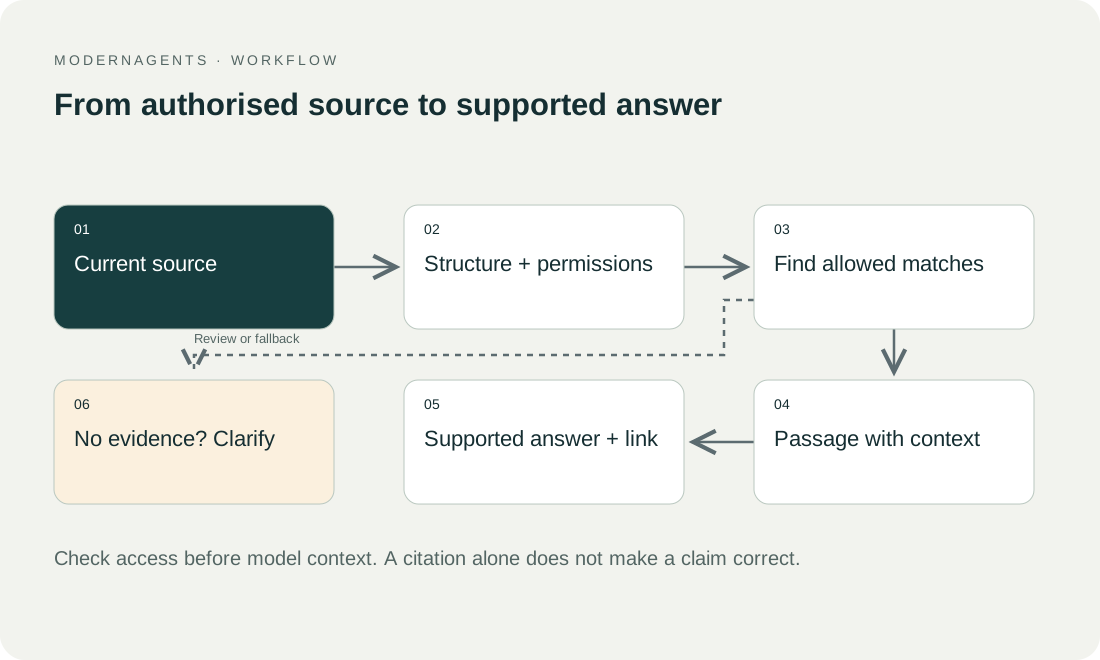
Your internal knowledge base may span procedures, product details and approved templates in several systems. We help assess whether existing search is enough, then implement a bounded knowledge assistant where a gap remains. The project defines permitted sources, access checks, citations and what happens when no reliable answer is available.

See the proposed workflow →

30 minutes, no obligation, German or English. Bring questions and a source inventory; confidential files are not needed for the first call. Clicking loads Cal.com (USA); the call runs on Google Meet. Prefer to write first? Ask by email. We send the draft data processing agreement and our terms on request.

Scope
Identify the question, signed-in user and permitted sources before searching.How it works · step 1/3
Retrieve
Find relevant passages with their source, version and access context.How it works · step 2/3
Verify
Present a supported answer or a visible gap with a route to the responsible person.How it works · step 3/3

In short

We help assess whether existing search is enough, then implement a bounded knowledge assistant where a gap remains. The project defines permitted sources, access checks, citations and what happens when no reliable answer is available. Bring questions and a source inventory; confidential files are not needed for the first call. The written proposal and terms govern scope, credit and any refund.

Choosing the scope

Start with a question set your team can evaluate

RAG combines retrieval with answer generation. It does not itself guarantee correctness or enforce every source permission. The useful trial tests the full route from identity and source selection to a checkable result.

Existing tools first

Compare current search and licensed assistant features on the same questions. Additional implementation needs a specific benefit, such as a missing source, an approval step or a defined operating requirement.

  • Sources with owners

    Choose a limited collection of procedures, manuals or approved templates. Record who maintains each source, which version is current and how conflicts are resolved. Avoid importing every folder by default.

  • Access as an acceptance condition

    Check how each source's permissions reach retrieval, cached answers and logs. Test different identities and revoked access. A prompt that tells the model to protect secrets is not an authorization system.

  • Answers with usable evidence

    The intended output includes the relevant passage and source version. Test whether the passage supports the actual claim. A plausible citation can still point to the wrong document or period.

  • Updates, deletion and unavailable sources

    Agree refresh intervals and how changed or removed documents affect the index. If the source cannot be checked, the answer must not pretend to reflect a freshly verified state.

  • Measure the remaining search work

    Include reading, source verification, clarification and manual lookup in the comparison. Count correct refusals separately from answered questions; do not promise a universal accuracy percentage.

Data and operation

Document the complete data route

A knowledge assistant can involve source systems, an index, model providers, caches and logs. For each country and entity involved, assess the actual data and applicable requirements. English-language access, internal use and EU hosting do not resolve the entire assessment.

Source permissions
Name an owner for groups, guest access and revocation. Confirm how permissions are enforced in the selected implementation and prove the boundary with appropriate test accounts.
Hosting and model choices
Compare suitable managed services and self-hosted options. The proposal identifies processing locations and providers, plus the quality, hardware and maintenance trade-offs of local models.
Contracts and retention
Agree processing terms before using confidential material. Specify handling of prompts, source excerpts, logs and deletion, and select contractual and provider settings appropriate to the intended data use.
Professional decisions
The assistant helps find material. Legal, personnel and other consequential judgments need their own permitted process and domain responsibility; a retrieved paragraph does not make the decision for your team.

How it starts

From a bounded collection to an assessed workflow

  1. Intro call

    Free

    Describe five recurring questions, the relevant systems and who knows the correct answers. We assess whether improving existing search is sufficient.

  2. Trial run

    from €2,500 · credited towards implementation

    Agree sources, test identities and expected answers. Include ambiguous questions, obsolete material and access failures. The written proposal and terms govern scope, credit and any refund.

  3. Implementation and care

    Scoped fixed fee · care agreed separately

    Document connectors, ownership, updates, access and recovery. Agree which source or model changes require repeated acceptance checks, and who handles problems after launch.

The implementation of one contained workflow costs about €3,000 to €5,000. Projects with several processes and systems cost more, and the fixed fee is in your proposal before work starts. Ongoing care starts at €250 per month per workflow. 30 min · remote · no obligation. And if AI isn't the right tool, we'll say so.

Practical questions

Before connecting internal knowledge

01When is a licensed workspace assistant enough?

When it covers the required sources, access rules, answer checks and operating needs. We compare it with additional implementation instead of assuming custom development is necessary.

02Does RAG mean training a model on our documents?

Not necessarily. A retrieval workflow supplies relevant passages when a question is asked. Index storage, model processing and any provider use of data still need explicit review.

03Will existing permissions be copied automatically?

That depends on each connector and retrieval design. We assess the supported route and test allowed, denied and revoked access; a product name alone is not proof of permission inheritance.

04How is answer quality demonstrated?

With an agreed question set, independently defined expected answers, source versions and recorded results. The proposed acceptance worksheet is a starting point, not a claim of a completed benchmark.

05What if two documents disagree?

The design should identify the conflict and the source owner instead of silently selecting whichever statement sounds more plausible. Domain owners determine validity and precedence.

06What happens after a document is deleted?

The scope must cover the original, indexed copies and any cached answers. The trial tests the chosen deletion and update route; those behaviours are not inferred from the storage location. The implementation of one contained workflow costs about €3,000 to €5,000. Projects with several processes and systems cost more, and the fixed fee is in your proposal before work starts. Ongoing care starts at €250 per month per workflow. Read the article with the cost examples. Calculate with your own numbers.

Service and project scope

Who is it for?

For teams with recurring internal questions and maintained, access-controlled knowledge sources. An assistant does not automatically make poor or contradictory documentation reliable.

Use this outline for the introductory call. The individual proposal and agreed acceptance criteria define the commitment.

Robert Van Ysendyck

Robert Van YsendyckFounder & Managing Director

Bring the question, its authoritative source and the person responsible for that source. We can assess a useful first scope without copying your whole document collection.