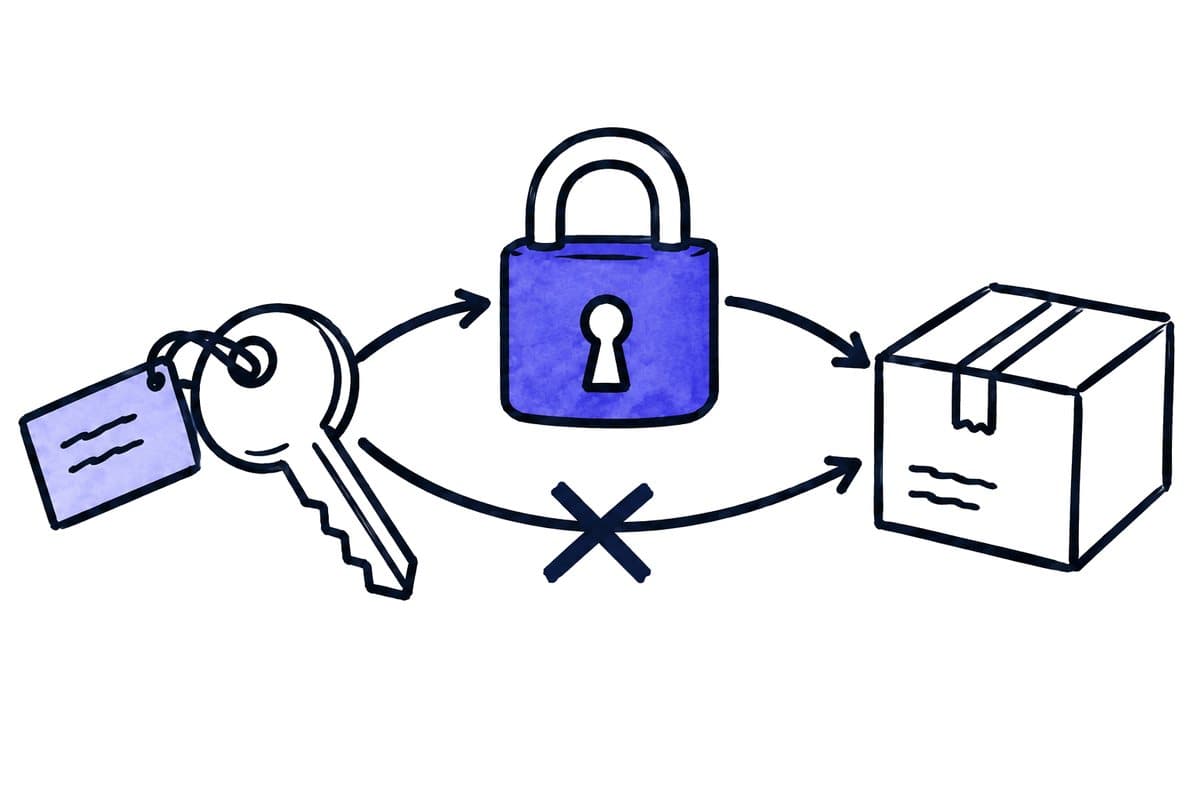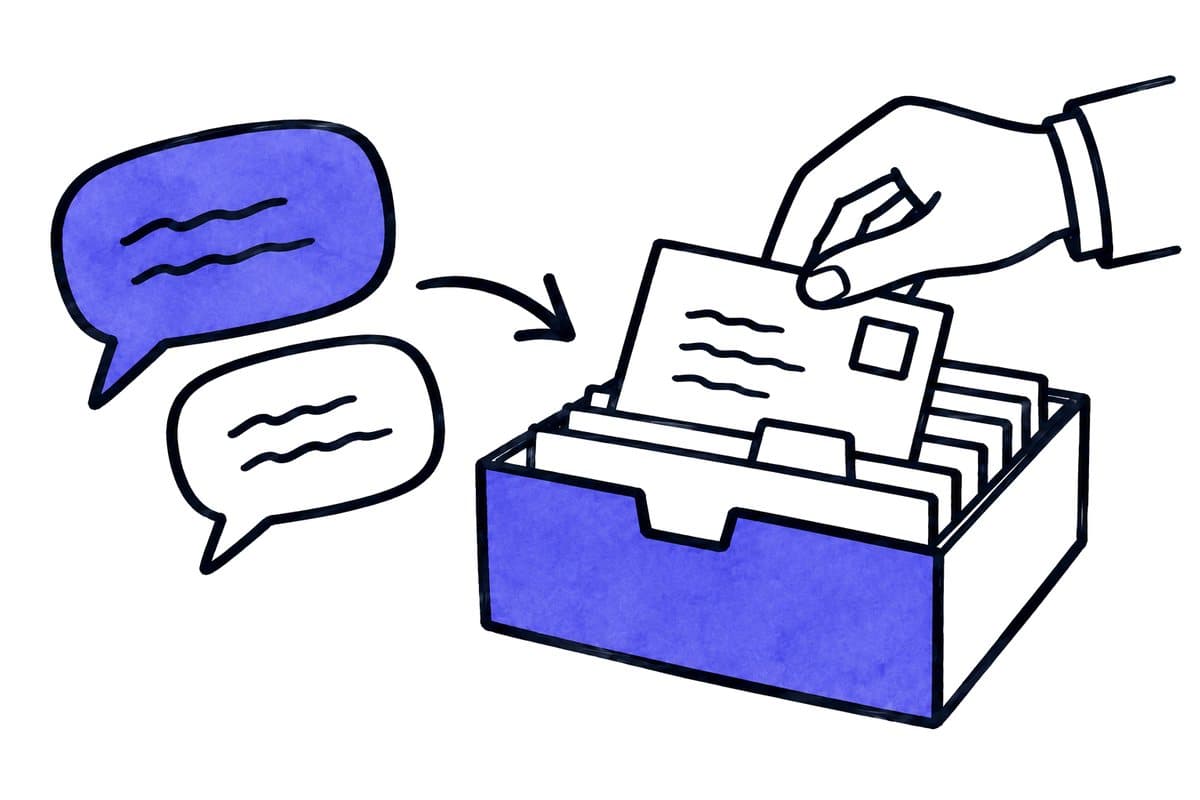
A CRM connection therefore needs a data model and handover rule before its dialogue is written. This guide uses HubSpot as a documented example. It describes a proposed workflow, not an integration we have already executed. The method can inform other CRM projects, but their fields, permissions and capabilities require separate confirmation.
Key takeaways
The main points for qualifying enquiries in a chatbot with CRM handover are:
- A CRM connection needs a data model and handover rule before its dialogue is written.
- If native HubSpot chatflow features cover the process, another write integration may be unnecessary.
- Contact identity and an individual enquiry need separate references, and an important detail that remains unknown is transferred as unknown.
- Asking for a response to a specific enquiry is not automatic permission for unrelated future campaigns.
01 / 14
What should lead qualification in a chatbot decide?
Start with information that helps sales conduct the next conversation. For an automation project, this might include the task, existing systems, approximate volume, desired timing and the person's role. Ask only for details that support an understandable decision.
Qualification may simply mean that the enquiry fits the service and can be assigned to a responsible team. It need not create a numerical score or immediately schedule a sales call. An existing customer seeking support may belong with service staff rather than in a new sales pipeline.
Explicitly prohibit unsupported inference. An unclear budget does not prove poor fit. A name, language or writing style should not produce unfounded judgments about spending power or decision authority. If an important detail remains unknown, transfer it as unknown.
02 / 14
Native HubSpot chatflow or custom integration?
HubSpot's rule-based chatbot documentation describes native chatflows and their setup requirements. Check the required actions and account entitlements before choosing a separate chatbot. Source checked on 27 September 2026.
If native features cover the process, another write integration may be unnecessary. An external AI interface can be useful for particular knowledge questions or channels, but then contact matching, fields, activities and failure handling need explicit design.
“Integrated with HubSpot” is too vague as a deliverable. Ask whether the result is an emailed summary, a contact record, an associated activity or an assigned staff task. Those outcomes differ both operationally and commercially.
03 / 14
When is a rule-based HubSpot chatbot enough?
Use a native, rule-based chatflow when the job is a predictable sequence such as collecting a work email, identifying the requested service and offering the appropriate next step. A conversational AI layer may be worth evaluating when users need answers from a larger approved knowledge collection or a supported action unavailable in the native flow. It adds another system to maintain and must justify that work.
The table lists five proposed cases to test first in the intended HubSpot account, each with the expected result.
| Proposed case | Test first in the intended HubSpot account |
|---|---|
| New prospect asks for a callback | Necessary fields are captured and the correct team can find the enquiry |
| Existing contact makes a new enquiry | The enquiry is associated correctly without overwriting unrelated contact information |
| User declines optional details | The dialogue still offers an appropriate contact route |
| Requested meeting type is unavailable | No appointment is described as booked |
| Native actions cannot produce the required outcome | Document the exact missing operation before commissioning an external integration |
A rule-based HubSpot chatbot and a generative customer agent are different product choices. Do not assume a tutorial for one establishes features or pricing for the other. In either case, judge the saved CRM state and the sales team's next action. You cannot judge whether the sales team can use a lead just by how fluently the chatbot asks qualification questions.
For wider service tasks, compare the customer chatbot options. Use the integration directory to distinguish documented connections from tested implementations.
04 / 14
Which CRM data model separates contact, company, enquiry and next action?
One person can submit several requests and discuss different tasks involving the same company. Do not put the whole current conversation into a general contact property that the next chat overwrites. Contact identity and an individual enquiry need separate references.
The table proposes a business data model for chatbot enquiries: where each piece of information belongs and which maintenance decision applies.
| Information | Proposed destination | Maintenance decision |
|---|---|---|
| Name and reachable address | Contact | Preserve origin and confirmed corrections |
| Organisation | Company association | Do not overwrite an existing association blindly |
| Task and systems | Enquiry or suitable activity | Retain separately for each request |
| Desired timing | Enquiry field | Distinguish unknown from immediate |
| Qualification reason | Reviewable assessment | Separate user statements from inference |
| Follow-up request | Task with accountable owner | Record channel and actual commitment |
| Marketing communication | Appropriate subscription setting | Do not infer it from chat participation |
This is a business model, not a ready-made HubSpot schema. Agree with the CRM owner which existing records and properties fit. Additional fields should have a clear user and maintenance purpose rather than filling the CRM with information nobody uses.
05 / 14
Synthetic dialogue with a verifiable outcome
Enquiry. A fictional prospect writes: “We want to automate invoice review, around 800 documents monthly, and we use BMD.” The bot clarifies whether the request concerns extraction, business approval or transfer. The reply is: “Approval before accounting, perhaps next quarter.”
Summary for confirmation. The bot can offer a summary for confirmation: approximately 800 monthly documents, a BMD environment, approval workflow and a desired discussion about next quarter. “Perhaps” remains uncertain. The bot must not record a verified BMD connection or an agreed project start date.
Confirmed next step. The prospect requests an email and provides an address. After successful CRM intake, the bot states the confirmed next step. If no appointment was booked, it must not announce a confirmed consultation. When only an enquiry was recorded, only receipt should be confirmed.
Sales view. The responsible salesperson sees confirmed details, unresolved questions and the chat origin. They need not reread the entire transcript, but can trace relevant statements to the customer. That is the practical value of qualification.
06 / 14
How do you validate field values without erasing uncertainty?
Interpretation rules. Numbers, selections and dates need explicit interpretation rules. “800 to 1,200 a month” should not silently become exactly 1,000. Preserve a range or an explicitly estimated value. “Next quarter” may justify clarification of the intended period.
Selection values. Existing selection properties need their actual internal values. An invented label such as “very urgent” might fail on import or fall into an unsuitable default status. Define the response to an unmappable value: clarification, a note or manual review.
Statements and assessments. Separate statements from assessments. “Customer reports two sites” is supplied information. “Enterprise potential” is an internal interpretation needing a defined rule. Label such judgments and let sales correct them.
Summary before submission. Before final submission, show a concise summary containing the fields that matter. Corrections should update the pending enquiry without silently changing unrelated established CRM information.
07 / 14
How do you handle duplicates and existing contacts?
A match is not authentication. A repeated email address may identify an existing contact record, but does not authenticate the person using the chat. Intake of a new enquiry and disclosure of confidential CRM information need different controls. A public bot should not reveal an existing contact's private details merely because someone knows their address.
API operations. The HubSpot contacts API documents different requirements for retrieval, updating and upsert. It specifically limits partial upserts using email as the identifier. Choose the actual operation according to the intended change rather than treating every chat as a complete contact import.
Overwrite policy. Agree an overwrite policy. An unverified company name supplied in a chat should not automatically replace a maintained company association. Store the discrepancy with the enquiry where appropriate and let the CRM owner determine whether it reflects a real change.
Got a workflow like this?
Tell me about it. Honest take and a rough price, usually within a day.
08 / 14
Does a follow-up request permit marketing?
Purpose. Asking for a response to a specific enquiry is not automatic permission for unrelated future campaigns. Define the purpose, notice and any required consent for the intended processing. HubSpot provides privacy and marketing-contact settings, but enabling them does not replace legal assessment.
Applicable rules. DACH projects need review of applicable privacy and communication rules. The GDPR framework informs relevant EU processing; the Swiss FDPIC explains ongoing responsibility for outsourced processing. This guide does not provide individual authorisation for marketing outreach.
Requested contact method. Record the contact method actually requested. An email follow-up request does not justify claiming that the prospect asked for a telephone call. Respect later corrections and ensure a repeated import does not reactivate an unsubscribed marketing preference.
09 / 14
What happens when only part of the CRM write succeeds?
Partial failure. A common integration problem affects only one step: the contact was created, but its follow-up task was not. Blindly repeating everything can create a duplicate contact while still leaving nobody responsible for responding.
State per step. Store confirmed identifiers and the state of each important business step. An unresolved operation might read: contact exists, enquiry stored, task failed. Recovery addresses the missing step specifically. The concrete system's supported retry behaviour must be tested rather than assumed.
Lost acknowledgement. A lost acknowledgement after successful creation also needs investigation. Check the actual CRM state using the operation reference before writing again. Do not promise an appointment or owner that the destination has not confirmed.
Later corrections. Test a subsequent correction too. If the customer changes the requested callback time while task creation is pending, recovery should use the latest approved request and retain enough history to explain the change.
10 / 14
How does sales take over the enquiry?
Monitored view. Decide which view the team monitors daily and what information each next action needs. A technically valid CRM record without an owner can easily be forgotten. Include absence, substitution and reassignment in operating acceptance.
Example. In the synthetic example, the salesperson responds to the confirmed enquiry. They can see that integration capability, start date and budget remain unresolved. They clarify those points instead of assuming a level of project readiness invented by the bot. This preserves a factual transition from first contact to sales discussion.
Unsuitable enquiries. Also define how unsuitable enquiries are handled. A courteous explanation or referral may be the correct result. Do not label such contacts qualified merely to improve a lead count.
11 / 14
Is appointment booking part of lead qualification?
Own acceptance. If the bot offers appointments directly, that step needs its own acceptance. A time displayed in the dialogue is not yet a confirmed booking. Check the calendar, time zone, responsible employee, duration and acknowledgement from the authoritative scheduling tool. The contact may be stored successfully while the selected slot has become unavailable.
Double click. In the proposed failure case, the prospect clicks the same slot twice. The expected result is one clear booking or an understandable clarification, rather than duplicate invitations. If confirmation is lost, the operator checks the existing calendar state first. A CRM task saying “appointment booked” cannot replace that verification.
Cancellation and rescheduling. Also decide what happens after cancellation. The enquiry may remain relevant even when the appointment disappears. Conversely, rescheduling should not automatically create a second sales opportunity. The relationship between contact, request and calendar event should remain understandable to staff.
Without calendar booking. A contact request without calendar booking may fully meet the initial need. Include scheduling in the service scope only when ownership, the supported calendar and exception handling are established.
12 / 14
Which acceptance tests and metrics show useful outcomes?
Include these cases in the acceptance test for chatbot lead qualification:
- a new contact
- an existing contact
- a changed address
- a missing required value
- declined marketing
- duplicate delivery
- partial failure
Open the resulting records as a salesperson. Verify that origin, unanswered questions, owner and next action are understandable.
Measure complete usable enquiries, accepted tasks, response time and subsequent assessed fit. Started chats and collected addresses are intermediate indicators. Also measure the work required for further qualification and duplicate cleanup.
Approval should produce an agreed field model, tested write strategy, clear communication purposes and a managed work queue. Lead generation then becomes a traceable CRM process whose outcome sales can use effectively.
13 / 14
Take the worksheet
Worksheet
Download the editable CSV table
| Information | Question | Boundary |
|---|---|---|
| Task | What needs improving? | No premature promise |
| Systems | Which tools are involved? | No unsupported compatibility |
| Volume | How often? | Label estimates |
| Timing | When is a decision needed? | No artificial urgency |
| Contact | Preferred reply method? | Separate marketing permission |
Columns to fill in, in the file: Your value / observation, Owner, Next action.
Download the editable CSV table (CSV). Add your own values, owners and open actions. This worksheet contains no measured client results.
14 / 14
Related decisions
These pages cover the service overview and the related decisions for chatbot lead qualification with a CRM:
- AI chatbots for customer service
- CRM automation in n8n without duplicate contacts
- Turn AI phone calls into usable CRM tasks
- Customer-service AI chatbots: plan the human handover
- Secure chatbot identity checks and business actions
For a workflow review, start with the task, systems involved and typical exceptions. Discuss it with modernagents.