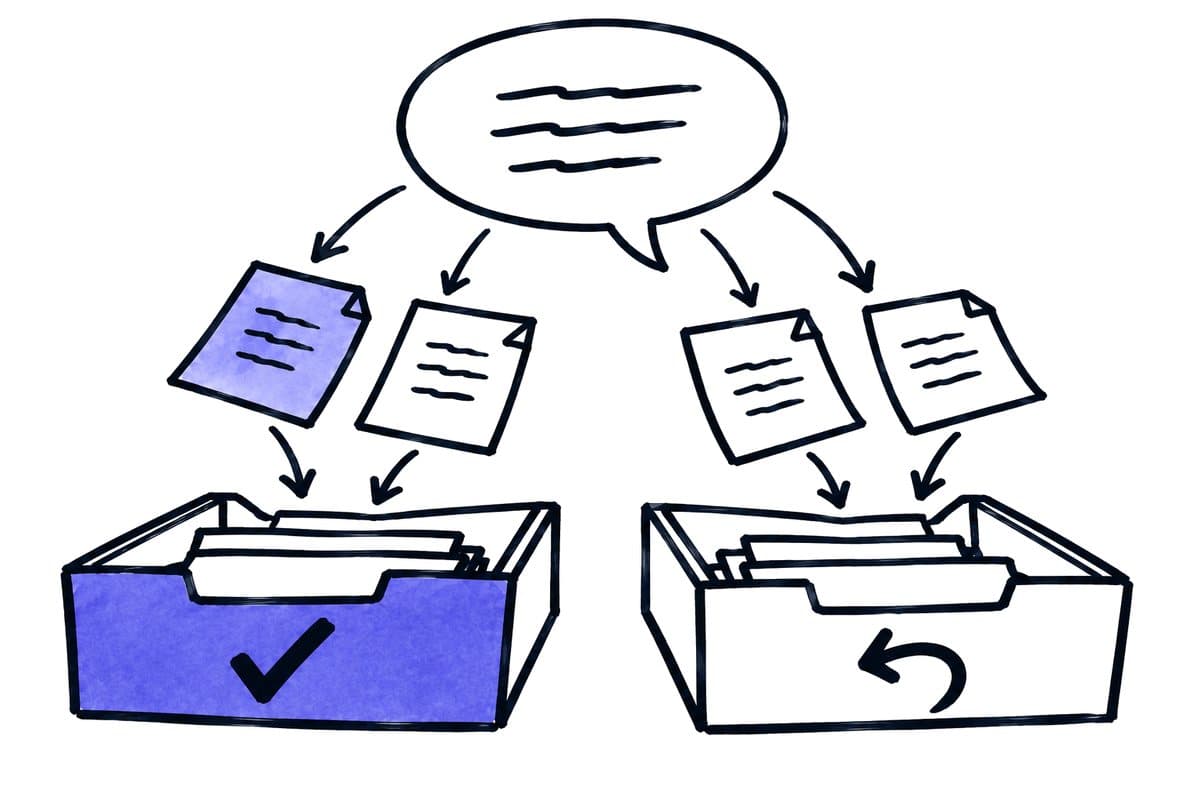
A quotation needs recipient markets, message categories, delivered volumes and the applicable pricing period. “1,000 chats monthly” is insufficient when a conversation contains differently priced messages. Keep the customer request separate from the billable message.
Key takeaways
The main points on WhatsApp chatbot costs are:
- When checked on 26 September 2026, the official WhatsApp pricing page still described service replies and certain utility replies as free, while Gupshup's documentation announced changes for 1 October 2026 that are not independently confirmed here.
- In the synthetic estimate, ongoing cost is €1,140 plus the message cost M; the four euro amounts are deliberately invented model assumptions, not published supplier prices.
- A German example rate is not automatically the Austrian or Swiss rate.
01 / 09
What do WhatsApp messages cost, and from which date?
Checked on 26 September 2026. The official WhatsApp pricing page describes charges for delivered messages that vary by market and category. When checked on 26 September 2026, it still described service replies and certain utility replies as free. An attempted send is not the same as confirmed delivery.
Announced for 1 October 2026. Meanwhile, Gupshup's own operational documentation dated 22 September announces changes for 1 October 2026: service-message charging after a stated free allowance and charges for utility messages within the service window. Gupshup attributes these to Meta, says its own fee remains unchanged and notes that details may change.
Not independently confirmed. We could not retrieve the corresponding Meta developer rate card during this check. The announced future account rule is therefore not independently confirmed here from that rate card. For use from October, obtain the then-current official card and written confirmation from your provider. Do not budget permanent free service or an announced allowance as an established entitlement without that check.
02 / 09
Which five cost layers belong in a WhatsApp chatbot quotation?
The table lists five cost layers of a WhatsApp chatbot quotation with the information to request and a common comparison error.
| Layer | Information to request | Common comparison error |
|---|---|---|
| Messages | Category, recipient market, delivery and effective date | Applying one price to every message |
| Platform provider | Base fee, numbers, seats and markups | Assuming passed-through charges are included |
| AI capability | Conversations, credits, models or included allowance | Treating a chat interface as fully included AI operation |
| Setup | Account, templates, knowledge, handover and testing | Budgeting only the technical connection |
| Operation | Maintenance, quality review and residual handling | Removing human follow-up from the calculation |
Mark each component as included, separately charged or unresolved. A low platform fee is comparable only when both offers cover the same capabilities and volumes. Also check currency, tax presentation, commitment and automatic top-ups.
03 / 09
How many messages does one request create?
One request. Take a representative request and list every outbound message. A greeting, three clarifications, two status updates and a final confirmation can create seven messages. Their charging depends on category, timing, recipient market and the applicable rules.
Service window. Distinguish replies within the permitted service window from later proactive contact. The WhatsApp Business policy sets separate requirements, including approved templates outside the relevant response window. An approved template does not itself establish a privacy or marketing-law basis for contacting someone.
Message volume. Do not estimate only from conversation counts. Short, fragmented bot replies can increase technical message volume. Combine related information clearly without overwhelming customers with excessively long blocks of text.
04 / 09
Synthetic estimate without invented DACH rates
Volumes. A fictional business expects 2,000 service requests each month. Each generates an average of six delivered outbound messages, producing 12,000 messages. Another 800 specifically planned notifications are sent. These are assumptions, not measured volumes or authorisation to send marketing messages.
Message cost M. For each category and recipient market, multiply the confirmed billable quantity by the applicable unit price. Apply any confirmed allowance according to its actual rules, rather than subtracting it from every category indiscriminately. The total produces message cost M.
Other ongoing costs. Now assume €180 for the platform, €120 for AI usage, €240 for maintenance and €600 for remaining staff work. Ongoing cost is therefore €1,140 plus M. Those four euro amounts are deliberately invented model assumptions, not published supplier prices.
The table collects the synthetic assumptions of this estimate.
| Item | Synthetic assumption |
|---|---|
| Service requests per month | 2,000 |
| Delivered outbound messages per request | 6 on average, 12,000 in total |
| Specifically planned notifications | 800 |
| Platform | €180 |
| AI usage | €120 |
| Maintenance | €240 |
| Remaining staff work | €600 |
| Ongoing cost | €1,140 plus message cost M |
Fewer messages. If four rather than six outbound messages suffice per request, the corresponding volume falls from 12,000 to 8,000. The saving still depends on how much of that volume is billable. Claiming a fixed euro saving without that information would be misleading.
Got a workflow like this?
Tell me about it. Honest take and a rough price, usually within a day.
05 / 09
Why map Austria, Germany and Switzerland separately?
Recipient markets. The company's location alone does not determine every message charge. Identify recipient markets and their mapping in the current rate card. Check regional groupings and currencies; a German example rate is not automatically the Austrian or Swiss rate.
Market shares. Show the three market shares explicitly, for example in separate quantity columns. If customers travel or use foreign numbers, ask the provider which attribution rule determines billing. Use the documented rule instead of guessing from a customer's physical location.
Check date. Record when the quoted rate was checked and who confirmed the account's treatment. This makes later differences between the forecast and invoice easier to investigate without reconstructing an outdated web page.
06 / 09
Which testing, peak and spend-control costs should you include?
Test units and allowances. Ask whether test messages, internal previews or delivery retries create additional units. Establish what happens when an allowance is exhausted. Automatic purchasing, a stopped capability and staff handover have different financial and service consequences.
Spend alerts. A spend alert needs an owner and an action. A sudden increase may result from a campaign, an incident or a conversation loop. Operators should identify the cause and disable the affected automation selectively.
Low-usage month. Also budget a low-usage month. Fixed platform and maintenance costs remain even when fewer requests arrive. A seasonal business may therefore need a different contract structure from one with stable daily demand.
07 / 09
How do you compare offers using identical workloads?
Give suppliers the same market mix, dialogue volumes, planned templates and staffed hours. Request estimates for normal operation, peak load and a changed message-pricing model. Mark unresolved assumptions and require the applicable effective dates.
A defensible comparison ends with a traceable total-cost calculation and a verified service route. A cheaper message provides little benefit if the customer must then call again. Assess cost per meaningfully completed request, including maintenance and remaining human work.
08 / 09
Take the worksheet
Worksheet
Download the editable CSV table
| Cost | Input | Evidence |
|---|---|---|
| Platform | Delivered billable messages by market/category | Current rate card |
| Provider | Fee and markup | Offer |
| AI | Included or extra usage | Billing unit |
| People | Handover and care | Own sample |
| Setup | Configuration and integration | Defined scope |
Columns to fill in, in the file: Your value / observation, Owner, Next action.
Download the editable CSV table (CSV). Add your own values, owners and open actions. This worksheet contains no measured client results.
09 / 09
Related decisions
These pages cover the service overview and the related decisions about WhatsApp chatbot costs:
- AI chatbots for customer service
- Plan a WhatsApp chatbot for business service
- Compare chatbot costs per useful outcome
- Measure resolved chatbot requests and remaining work
For a workflow review, start with the task, systems involved and typical exceptions. Discuss it with modernagents.