
Key takeaways
- A process pattern can transfer between sectors while its approval cannot simply be copied.
- Four patterns recur: incoming work needs a dependable identity, a draft is not a completed case, professional responsibility remains specific to the sector, and peaks require concrete capacity planning.
- A first workflow needs a recurring input, a verifiable outcome and someone who owns the business process.
- This comparison is not a representative industry study, a report on ten completed client projects or a claim of particular savings.
This comparison describes ten possible applications and three synthetic examples. It is not a representative industry study, a report on ten completed client projects or a claim of particular savings. The linked guides explain each work area. Official sources for the professional boundaries described here were checked on 26 September 2026.
01 / 11
Which bounded starting point suits each of ten industries?
The examples focus on preparatory office work. Calling something a candidate means a business can investigate data access, responsibility and value. It does not establish universal suitability or legal permission.
The following table shows a possible first workflow for each of ten industries and the decision kept separate from it.
| Industry | Possible first workflow | Decision kept separate |
|---|---|---|
| Tax firm | Match missing documents to a client and accounting period | Tax interpretation and submission decisions |
| Law firm | Prepare incoming documents for matter handling | Authoritative deadline control and permitted transmission |
| Property management | Capture a damage report with property, contact and owner | Commissioning work and binding commitments |
| Skilled trades | Prepare callbacks with location and request details | Technical assessment and binding quotations |
| Medical practice | Route administrative enquiries into a staffed process | Clinical assessment and treatment |
| Insurance broker | Identify missing documents for a case | Advice and confirmation of cover |
| Freight forwarder | Match status requests to a transport order | Unconfirmed delivery promises and dispatch decisions |
| Hotel | Answer recurring questions from approved information | Unconfirmed bookings or price changes |
| Car dealer | Prepare workshop enquiries with vehicle and contact details | Repair approval and binding estimates |
| Staffing agency | Organise documents and appointment requests | Unreviewed candidate evaluation and selection |
An industry label alone is therefore insufficient for a useful proposal. Two property-management businesses may have different ownership structures, permissions and systems. A hotel and a trades business may need technically similar callback processes while retaining different business rules.
The appropriate starting point also depends on volume and available software. A candidate that looks attractive in this table may already be handled by a native feature. Another may require data that the business cannot access reliably. Treat the comparison as a way to ask better questions, not as a shopping list of projects that every company should implement.
02 / 11
Pattern 1: incoming work needs a dependable identity
Missing identifiers. A message does not always contain the identifier required by the destination system. Tenants may use an informal address, customers refer to “my last order,” and a document may carry only a surname. A model can propose an interpretation, but assignment to the correct case still needs to be verifiable.
Required information. Define the required information for each workflow. A property report might need the building, unit and callback contact; a transport enquiry needs an order reference. If a critical detail is absent, ask a targeted question or send the case for manual matching. An invented customer number would put every later step on the wrong foundation.
Matching and permission. Also separate matching from permission. Knowing an order number does not necessarily authorise someone to see all records associated with it. The appropriate check depends on the information being accessed. Resolve that question in the workflow design before releasing personal details.
Several identifiers. Where several systems use different identifiers, document the mapping explicitly. The public booking reference, internal case number and accounting customer number may all refer to the same relationship without being interchangeable. A readable summary cannot compensate for writing into the wrong record.
03 / 11
Pattern 2: a draft is not a completed case
States. Across all ten examples, the states of work should remain distinguishable. A request may be received, assigned, prepared, reviewed and finally confirmed. A failure can interrupt processing between those states. Without that distinction, an automatic reply may sound more final than the underlying transaction actually is.
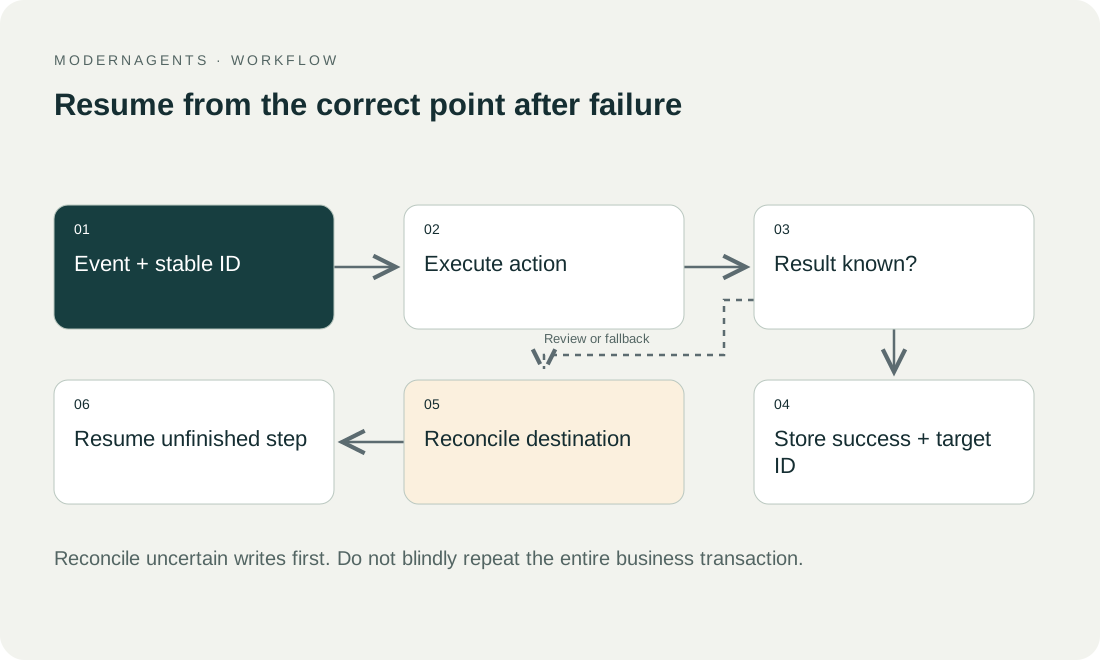
The diagram illustrates a general operating principle: unfinished work stays visible, and a retry considers whether the destination already accepted a change. It is not a tested integration with a particular industry application.
Completion. Define completion precisely. “Callback created” means a saved task with a responsible team. “Appointment booked” requires a confirmed booking. “Document submitted” is different from a PDF generated locally. Precise language helps employees and customers understand the actual state.
Recovery. The same care applies when recovering a failed run. Before repeating a write, establish whether the first attempt changed the destination. Otherwise, a reasonable attempt to recover missing work can create duplicate appointments, tickets or instructions. Keep uncertain outcomes visible until the system or a person resolves them.
04 / 11
Pattern 3: professional responsibility remains specific to the sector
Tax firms
Germany's Federal Chamber of Tax Advisers describes AI as an aid while professional responsibility remains with the adviser. Its January 2026 FAQ identifies July 2025 as its underlying legal reference date, so current individual questions need further review. Chamber AI FAQ.
Medical practices
For medical practices, Germany's KBV states that AI supports clinical work while responsibility for treatment remains with clinicians. KBV guidance on AI. A reception project should not therefore be casually expanded into an autonomous clinical decision service.
Law firms
For German law firms, beA is a specific professional communication channel with its own access and use requirements. The BRAK overview of beA and electronic legal communication is a different starting point from an ordinary email integration. A generic inbox workflow cannot replace those requirements.
Insurance
EIOPA's AI governance opinion is addressed to national insurance supervisors and explains the relationship with insurance-sector requirements. It is not a certificate for an individual broker application. EIOPA opinion of 6 August 2025.
Project planning
For project planning, describe the permitted preparatory task separately from the professional decision. Establish with the responsible specialist who may view, amend, confirm and transmit each piece of information. One technical platform can support several workflows without making their professional boundaries identical.
05 / 11
Pattern 4: peaks require concrete capacity planning
Own measurements. A hotel may receive many similar requests during an event, a workshop during a seasonal tyre change and a firm before recurring submissions. That does not establish one universal deadline or common busy season for every business. Measure your own arrivals by week, request category and handling time.
Peaks and urgent cases. Distinguish predictable peaks from individual urgent cases. A high volume of general questions needs different handling from a safety-related request. The design therefore needs both volume planning and an explicitly defined route for urgent or excluded content.
Follow-on work. Include the follow-on human work. If an assistant collects eighty callbacks overnight, the team needs capacity and priorities the next morning. Improved availability helps only when the newly visible workload is subsequently handled. Automated capture does not replace a staffed queue.
Vendor comparison. When comparing vendors, use the same peak scenario. Average monthly volume can hide requirements for concurrent calls, simultaneous bookings or time-sensitive review. Ask what happens during the busiest relevant interval and how unfinished work remains visible afterwards.
Got a workflow like this?
Tell me about it. Honest take and a rough price, usually within a day.
06 / 11
Synthetic example A: a property damage report
Request and preparation. A person reports water in the stairwell by email and attaches two photographs. The proposed workflow captures the content, checks the property reference and prepares a case. An approved rule determines which responsible team should receive the notification. The system does not make a remote technical diagnosis or claim that a contractor has already been commissioned.
Open points. If the exact address is missing, that uncertainty remains visible. If the responsible contact cannot be reached, the case remains open for escalation. Staff can see what arrived, which details were confirmed and which action is outstanding. Actual emergencies require a professionally defined and tested response procedure.
Acceptance. Acceptance should also include a duplicate report. If two messages concern the same event, the integration should not blindly create conflicting work orders. Uncertain merging remains a human decision. This example illustrates process boundaries; it does not claim an actual deployment or guaranteed prevention of damage.
07 / 11
Synthetic example B: a workshop enquiry at a car dealer
Request and preparation. A customer wants an appointment “as soon as possible” and mentions a noise in the vehicle. An assistant can structure the contact information, vehicle reference, preferred time and description. Actual capacity, necessary work duration and technical assessment must fit the workshop's process.
Confirmation boundary. If the integration only creates an enquiry, the reply should say so. An appointment confirmation is justified only after the required booking operation. If the customer changes the vehicle or adds another requested service, the original assumption needs checking. An empty calendar slot does not establish the amount of workshop time needed.
Tests. Useful tests include an incomplete vehicle identifier, an existing appointment and unavailable workshop software. In each case, the team should be able to distinguish a new enquiry, a change and an unresolved error. The intended value comes from better preparation and dependable handover, not a claimed automated diagnosis.
08 / 11
Synthetic example C: documents in a tax firm
Request and preparation. A firm receives records for several companies and different accounting periods. A preparatory workflow can capture documents, propose assignments and identify missing information. It needs to keep entities separate and present uncertain records for review.
Follow-up. An automatically drafted follow-up can help when it identifies the actual missing document and the correct recipient. It should not originate solely from an uncertain model guess. Before sending, check whether the document arrived through another route in the meantime. Otherwise, automation creates additional queries instead of reducing them.
Acceptance. An appropriate acceptance set includes contacts with identical names, corrected documents and late submissions. The objective is a traceable processing state for each client and period. Tax interpretation, relevant deadlines and professional approvals remain a separate review area. Our tax-firm document example develops the states and handovers further.
09 / 11
How do you measure the same process idea across sectors?
Different measures. A hotel might measure handling of recurring information requests, a firm the effort needed to obtain complete records and a trades business the quality of callback tasks. One metric does not automatically fit all three objectives. Count the desired case outcome and the human work that remains necessary to achieve it.
Synthetic calculation. In a purely synthetic calculation, four hundred cases each save two minutes, while forty exceptions add four minutes each. The net result is 800 minus 160, or 640 minutes: ten hours and forty minutes. At an assumed internal value of €45 an hour, this represents €480 of capacity value before software, support and implementation.
What it shows. This calculation does not establish a sector-wide return. It shows why exception rates and rework belong beside model speed in the assessment. Released capacity and actual cash savings are also different outcomes. The cost guide explains the complete calculation.
Quality. Compare quality as well as time. Faster handling with more wrongly assigned cases may be a deterioration. Choose a small set of measures that the team can inspect and connect back to actual work, rather than collecting a large dashboard that nobody uses to make decisions.
10 / 11
A first workflow needs more than a matching industry label
Selection. Choose a recurring input, a verifiable outcome and someone who owns the business process. Review existing software capabilities first. Then establish access, approvals, the failure route and ongoing support. A clear workflow is a better basis for choosing tools than a long list of possible AI features.
DACH differences. For DACH projects, account for real differences in specialist software, language, number formats, currencies, responsibilities and applicable rules. Translating text does not automatically adapt a German process for Austria or Switzerland. Record which configuration was actually reviewed.
Next reading. The automation-opportunity assessment helps select a candidate. The document-processing guide and telephone-assistant guide then lead to the relevant implementation questions. The transferable element is the careful process description; each industry and each business adds its own boundaries.
11 / 11
Related decisions
The following pages and articles cover related decisions for a first automation project.