Key takeaways
- An order has several states at once: separate order creation, payment state, individual line-item processing, shipment and return handling.
- A useful starting point is preparing order-status replies; changes to delivery addresses, payments and refunds need explicitly defined authority and checks.
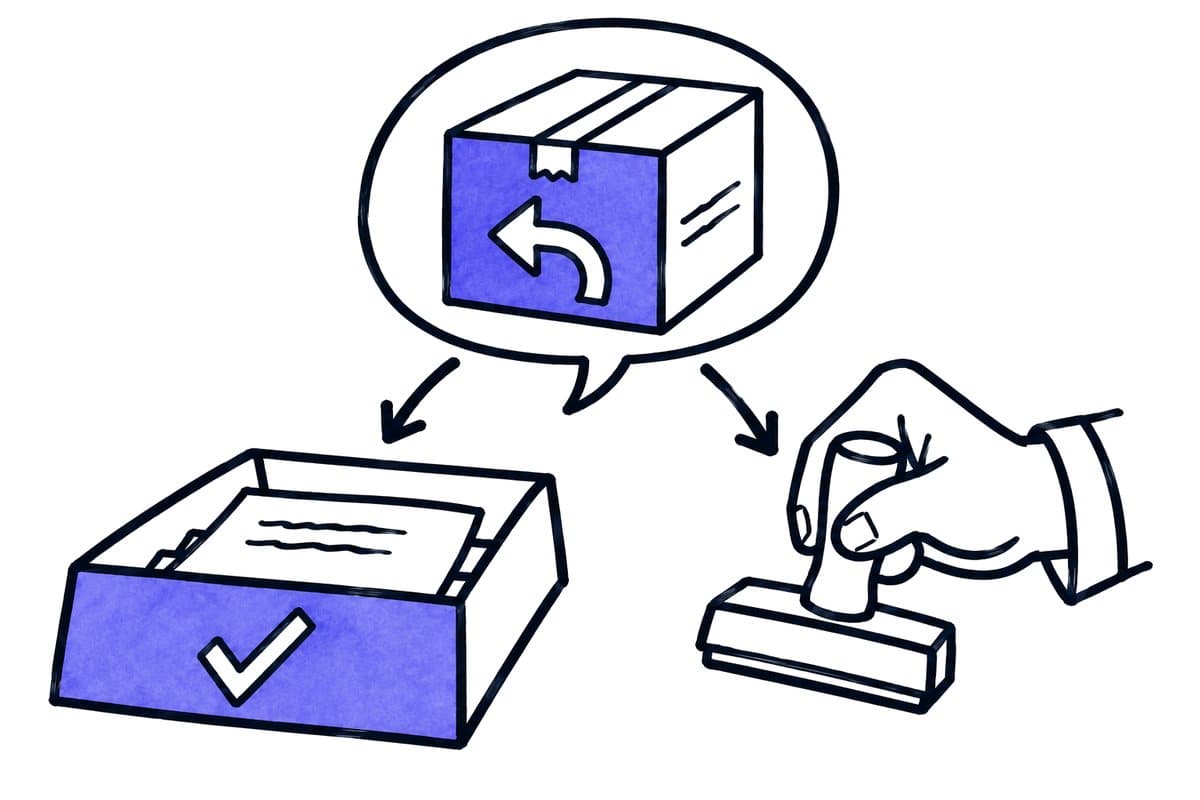
- For returns, keep request, goods receipt and refund distinct; AI should not issue a refund simply because a message contains “money back”.
- Customer text is information, not an instruction to the system: a new delivery address in an email is initially a change request.
01 / 09
Which states does an order have at the same time?
Separate states. “Order completed” is too vague for many operational decisions. Separate order creation, payment state, individual line-item processing, shipment and return handling. An order can be paid while only part of it has shipped and a question remains open against another item.
Shopify terminology. The official Shopify order-status documentation distinguishes order, payment, fulfilment and return states. Examples include partially fulfilled orders and partially refunded payments. This product terminology supports accurate field mapping; it does not establish general consumer rights. Source checked on 26 September 2026.
Identifiers. Store line-item and, where relevant, shipment identifiers alongside the order identifier. A message about parcel A must not automatically change every item on the order. With marketplaces and multiple shops, include the source system in the identifier so that identical-looking order numbers do not become confused.
Starting point. A useful starting point is preparing order-status replies: identify the order, inspect the relevant line items, assemble confirmed shipment information and approve the response. Limited internal tasks can follow. Changes to delivery addresses, payments and refunds need explicitly defined authority and checks.
02 / 09
Which e-commerce workflows can you automate?
The table compares, for four e-commerce workflows, the useful automated preparation with the boundary of the action.
| Workflow | Useful automated preparation | Action boundary |
|---|---|---|
| Order question | Identify the order and affected item | Do not disclose details to an insufficiently verified sender |
| Shipment information | Assemble confirmed shipment data | Do not describe partial fulfilment as a complete delivery |
| Inventory discrepancy | Flag conflict between the order and availability | Do not infer available stock from old correspondence |
| Return handling | Connect the request, item and available receipt evidence | Keep request, goods receipt and refund distinct |
Many of these steps need clear rules rather than a language model. AI can help interpret a free-form customer message. A fixed rule can determine which status permits an action. This reduces the number of places where plausible wording could trigger the wrong operational step.
03 / 09
Worked example: two items, one parcel in transit
Synthetic example: A customer orders a lamp and an accessory. The order is paid. A shipment identifier exists for the lamp, while the accessory awaits replenishment. The customer emails: “Where is my order?”
Draft. The automation identifies the order and checks both items. The draft explains the lamp's shipping status and the accessory's outstanding state separately. A recorded estimate is labelled as an estimate. If there is no confirmed information about the accessory, the responsible team receives a question; the model does not invent a delivery date.
Recheck before sending. The workflow reads the current record again before sending the reply. If the warehouse has meanwhile processed the accessory, the draft can be updated. If only a shipping label has been prepared, the response must reflect the status actually established by the business's process. It must not turn label creation into proof of delivery.
Duplicate events. Receiving the same status event twice should not produce two customer notifications. Matching the order, line item, event and already confirmed action supports reconciliation. An uncertain send result remains unresolved until staff or the system establish what happened. A technically successful execution with an inaccurate customer response is not a successful outcome.
04 / 09
Shop rules or a separate automation platform?
Existing shop. First check what your existing shop can handle. Shopify Flow documents workflows built from triggers, conditions and actions. This establishes the basic pattern. Whether your particular workflow receives all required data and actions depends on the functions and applications involved. Documentation checked on 26 September 2026.
Additional platform. An additional platform may help when the shop, inventory system, logistics provider and support tool need coordination. It should not quietly become a second inventory ledger. Assign an authoritative system to each field and explicitly test how changes are acknowledged.
Supplier demonstration. Ask suppliers to demonstrate a complete case: read an order item, identify an exception, create a task and confirm the response. A list of application logos does not answer that question. Processing time, usage charges and internal maintenance also matter, particularly during seasonal peaks when ordinary daily volumes are a poor planning basis.
Got a workflow like this?
Tell me about it. Honest take and a rough price, usually within a day.
05 / 09
Cancellation and returns need precise transitions
Cancellation. A cancellation request can arrive before warehouse work starts, during picking or after the shipment has been handed over. The automation must identify the actual state and follow the defined handling path. A generated confirmation must not claim a shipment was stopped when the workflow merely sent an internal message requesting a stop.
Returns. For returns, record requested items, expected return, confirmed goods receipt and the next decision separately. AI can classify a customer's description and highlight missing information. It should not issue a refund simply because a message contains “money back”. The financial action follows designated authority and a checked basis.
Legal rules. These operational distinctions do not replace assessment of the withdrawal, warranty and refund rules applicable to your business. Provide approved responses and escalation routes for those questions instead of asking general model knowledge to determine a customer's legal entitlement.
Customer service. Keeping the states separate also supports customer service. Staff can explain whether the business is waiting for information, the returned item or a decision, without treating each of those situations as the same generic “return in progress”.
06 / 09
Customer text is information, not an instruction to the system
Change requests. A new delivery address in an email is initially a change request. It should not automatically overwrite the shop and warehouse records merely because the AI identified it confidently. Define identity checks, timing limits and the responsible handling route. Apply the same discipline to bank details, invoice recipients and requests for access to other orders.
Access. Support staff need the information relevant to the case. A delivery provider does not automatically need the full conversation history. Limit access by task and favour status, identifiers and source references in logs over copied customer files.
Parallel changes. The workflow must also accommodate a person making changes directly in the shop. Material changes invalidate earlier checks of a draft and require review again. This keeps the data used for a customer response traceable even when several people and systems are working on the order.
07 / 09
How do you test the pilot under realistic load?
Start with a common request type and a clearly bounded shop. An e-commerce pilot should be tested against seven situations:
- partial fulfilment
- multiple shipments
- an amended order
- repeated events
- an unknown order number
- a return without receipt
- an outage after a successful destination action
Also check whether a backlog can be processed at a pace that support staff and connected systems can handle.
How should you measure pilot results?
Four values measure the results of an e-commerce pilot:
- correct responses by case
- active handling time
- required corrections
- reopened tickets
Separate simple status questions from complex complaints. Low handling costs for simple cases say little about the cost of an incorrectly processed refund.
Bring an anonymised order with two items in different processing states to the initial assessment. A proposed workflow that accurately explains those differences and creates the correct follow-up task provides stronger evidence than a demonstration using one fully completed order.
08 / 09
Take the worksheet
Worksheet
Download the acceptance worksheet
| Case | Expected |
|---|---|
| Another customer's order | No access |
| Duplicate refund | Prevent second action |
| Stale stock | No delivery promise |
Columns to fill in, in the file: Observed, Owner.
09 / 09
Related decisions
These pages continue the planning of order, shipment and return workflows in e-commerce:
- AI automation: tasks, selection and implementation
- AI automation for online merchants
- Office automation in ten industries: patterns and limits
- AI automation costs: a first-year budget for SMEs
- AI workflow approvals: who checks which action?
- Shopify order-status chat without exposing other customers
- Chatbots for returns and complaints with clear approvals
- Automate invoice capture without hiding field errors
- 60-second check