Key takeaways
- Not found, ambiguous and conflicting information is exposed for review rather than filled with an invented default or the first match found.
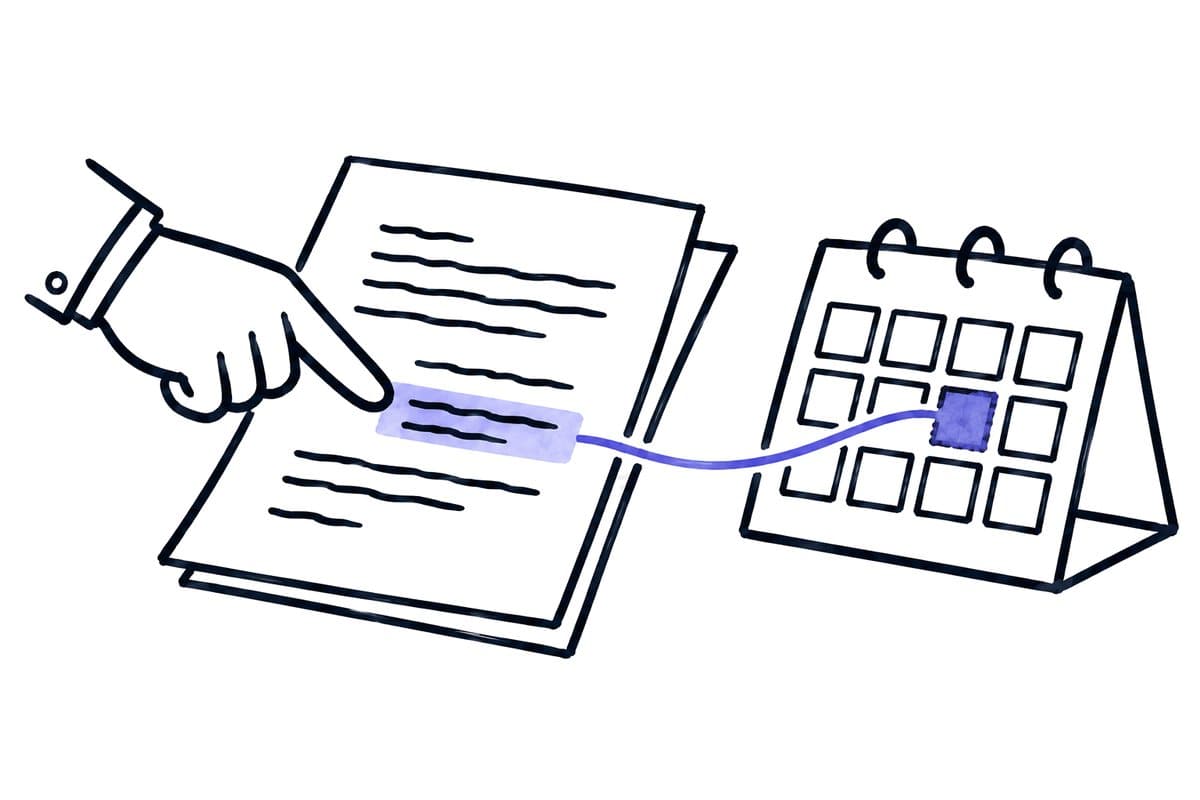
- In the synthetic renewal example, extraction captures commencement, minimum term and notice wording, but does not yet write a binding termination date into the calendar.
- Update the register only after the necessary review, and record who approved which information.
01 / 09
Which administrative task should contract extraction serve?
A concrete objective. Start with a concrete objective, such as maintaining a contract register or preparing a list of upcoming renewal reviews. “Check contracts” is too broad. A register needs different information from legal risk analysis or a decision about whether termination would be effective.
Direct fields versus later assessment. Define which fields must appear directly in the document and which require later professional assessment. Contracts can contain signature dates, commencement dates, minimum-term endings and amendment dates. Do not collapse them into a single contract-date field.
Product support. Check product support against the collection. Microsoft's prebuilt Contract model describes fields including parties, identifier and title, but explicitly identifies English-language documents as its supported scope. General multilingual OCR support therefore does not prove suitable German contract extraction with that particular model. Microsoft Contract model, checked on 26 September 2026.
02 / 09
Which contract fields belong in a schema with source evidence?
A contract extraction schema preserves evidence for seven fields and marks an important boundary for each:
| Field | Information to preserve | Important boundary |
|---|---|---|
| Parties | Name, role and source | Do not confuse parties with contacts |
| Identifier | Original value | Do not invent a missing number |
| Commencement | Wording and any explicit date | Check conditions affecting effectiveness |
| Term | Express wording | Separate initial term and renewal |
| Termination | Clause, location and open questions | Not yet a binding deadline |
| Amendment | Reference and affected sections | Assess order and applicability |
| Status | Draft, signed version or unresolved | Do not infer execution from filename alone |
Store the wording or a sufficient excerpt with page and section. A bare model value without evidence makes verification difficult. For scans, the review interface should open the relevant image region. Long documents also require surrounding context rather than an isolated sentence.
03 / 09
How do missing, ambiguous and conflicting information differ?
Not found can mean information is absent, recognition failed or an unavailable appendix contains it. Do not treat these as automatically equivalent. Use a review status rather than an invented default.
Ambiguity arises with several parties, different service periods or separate termination provisions. A conflict can exist between the main agreement and an amendment. Expose these cases instead of accepting the first match found.
Missing, ambiguous and conflicting contract information are three different statuses:
| Status | What it can mean | Response |
|---|---|---|
| Not found | Information is absent, recognition failed or an unavailable appendix contains it | Use a review status rather than an invented default |
| Ambiguous | Several parties, different service periods or separate termination provisions | Expose the case instead of accepting the first match found |
| Conflicting | A conflict between the main agreement and an amendment | Expose the case instead of accepting the first match found |
Document families and versions
Maintain document families. Main agreement, schedules and amendments belong together while retaining individual identifiers and versions. A new upload must not silently overwrite the previous state. A responsible reviewer determines which material governs the current assessment.
Record missing attachments explicitly. If a clause refers to a schedule that is unavailable, the system should preserve the reference and open a completeness task. A confident summary of the available pages cannot establish what the missing schedule says.
04 / 09
Synthetic example of a renewal clause
The agreement. An invented agreement states that it starts on 1 March 2026, has a twelve-month minimum term and contains a renewal provision. Notice is described as required three months before expiry. A later amendment changes service scope without making its effect on term completely clear.
What extraction captures. Extraction can capture commencement, minimum term and notice wording with source evidence. It should also flag the amendment as potentially relevant. It should not yet write a binding termination date into the calendar. The governing version, interpretation and other applicable conditions require professional assessment.
After review. After review, the owner confirms an internal handling date and, where appropriate, an earlier preparation task. The register distinguishes that confirmed result from extracted raw information. The workflow does not send a termination notice or claim legal assessment is complete.
Why synthetic. This is deliberately synthetic. It demonstrates the boundary between useful extraction and a legal conclusion without calculating a real contract deadline.
Got a workflow like this?
Tell me about it. Honest take and a rough price, usually within a day.
05 / 09
How do you get from source documents to an approved register?
The path from source documents to an approved contract register has six steps:
- Record source, version and completeness.
- Check language, readability and schedules.
- Run extraction against the agreed schema.
- Rules validate formats and required evidence.
- A specialist reviews uncertain or consequential fields.
- Update the register only after the necessary review, and record who approved which information.
A change to a relevant clause should reopen affected follow-up tasks. Earlier approval must not silently apply to a new amendment.
Ensure the register links back to the original. Exporting a spreadsheet is of limited value if its evidence cannot be found later. Storage and permissions therefore belong in acceptance of the complete process.
If a record has been distributed to another system, define how corrections propagate. Otherwise an updated register may coexist with an obsolete calendar reminder. Track affected outputs so an approved change can be carried through consistently.
06 / 09
How should confidential contract material be processed?
Contracts may contain personal information and trade secrets. Restrict access and establish which services retain originals, text and model responses. Austria's data-protection authority explains the GDPR's technology-neutral application to AI, while the Swiss authority explains the application of Swiss law. Austrian authority guidance, Swiss FDPIC guidance.
A publicly accessible online tool is not automatically an appropriate destination for real contracts. Begin with synthetic examples and assess the intended service, its terms and access arrangements before processing production material.
Keep diagnostic records proportionate. A case identifier and error category may be enough for routine operation; full contract text should not be copied into every log simply because it is convenient for troubleshooting.
07 / 09
How do you test the quality of evidence and decisions?
Include an agreement without an end date, multiple parties, missing schedule, amendment, poor scan and deliberately conflicting information. Have expected fields and unresolved legal questions labelled independently. For an ambiguous case, requires professional review can be the correct outcome.
Measure field correctness, source accuracy, missed conflicts and review effort. A fluent summary does not replace a verifiable register. Start with one contract category, a bounded field schema and a responsible professional who can approve the actual transfer into operational records.
08 / 09
Take the worksheet
Worksheet
Download the editable CSV table
| Field | Required context | Review rule |
|---|---|---|
| Parties | Document and role | Do not merge similar names |
| Start | Relevant condition | Signature date may differ |
| Duration | Renewal and exceptions | Do not isolate one number |
| Notice period | Wording and reference date | Professional review |
| Amendment | Relationship to main agreement | Check changed terms |
Columns to fill in, in the file: Your value / observation, Owner, Next action.
Download the editable CSV table (CSV). Add your own values, owners and open actions. This worksheet contains no measured client results.
09 / 09
Related decisions
These guides and service pages cover the decisions next to contract data extraction:
- AI document processing: capture, review and transfer
- Data protection across a document-processing workflow
- Prepare PDFs, scans and tables for RAG
- AI workflow approvals: who checks which action?
- Handle poor scans and handwriting in document capture
For a workflow review, start with the task, systems involved and typical exceptions. Discuss it with modernagents.