Key takeaways
- Act: If you use Google Workspace, decide whether Gemini Notebook is allowed in your company. Admin access is on by default, and in the EEA, users whose administrator has enabled both services can switch on the connection in the Gemini app.
- Plan: If you run AI workflows through the OpenAI API or Microsoft Foundry, test GPT-6.1 Terra on your highest-volume workflows and compare quality and cost.
- Plan: If you run open-weight models as agents with tools, block outbound network access by default and log every tool call.
- Plan: If you use Google Vault, check whether Gemini in Workspace conversation history is on and how its deletion is set. Plan Vault retention rules for these conversations once Google adds them.
- Watch: Agent Skills under the Linux Foundation. The shared format may make some instructions easier to reuse across tools that support it.
01 / 06
GPT-6.1 Terra: prices and the EU data zone in Microsoft Foundry
What happened. OpenAI released GPT-6.1 Terra on 26 October 2026. According to OpenAI, the model is available in the API as gpt-6.1-terra and in ChatGPT Work and Codex for the Plus, Pro, Enterprise and Edu plans. It is also rolling out to ChatGPT Business workspaces, subject to workspace permissions. (ChatGPT Business release notes) For prompts of up to 272,000 input tokens, the standard API price per million tokens is 1 US dollar for input, 0.05 US dollars for cached input and 5 US dollars for output; longer prompts cost more. OpenAI states that standard API prices are 50% lower than for GPT-5.6 Terra and GPT-6.1 Sol. (OpenAI: Introducing GPT-6.1 Terra) The individual rates fall by different amounts: according to OpenAI's price list and model pages (as of 27 October 2026), the input price is half that of both models, while the output price is 5 US dollars instead of 12 (GPT-5.6 Terra) or 10 (GPT-6.1 Sol). According to the price list, regional processing (data residency) endpoints cost 10% more for models released on or after 5 March 2026. (OpenAI API pricing, GPT-5.6 Terra model page)
Microsoft made the model generally available in Microsoft Foundry on the same day, as Global Standard and as Data Zone Standard in the US, the EU and APAC. For Data Zone Standard (EU), Microsoft lists 1.20 US dollars for input and 6.00 US dollars for output per million tokens with short context, and 2.40 and 9.00 US dollars with long context. Global Standard costs 1.00 and 5.00 US dollars with short context. (Microsoft Foundry Blog: GPT-6.1 Terra now generally available)
What it means for SMEs. Workflows that process many documents or emails through a model can become cheaper per run. If you need processing in the EU, the EU data zone in Foundry costs 20% more than Global Standard for short-context input and output.
Our recommendation: plan. Run your two or three highest-volume AI workflows with gpt-6.1-terra on real cases, and compare the results and cost with your current model. How to set up such a test is described in Your own AI benchmark: test twenty real cases before you choose. If you use the EU data zone, check in Azure which regions offer the deployment before you switch.
02 / 06
Qwen3.8-Flash-Next: Cohere test shows an upload attempt to Beijing
What happened. On 26 October 2026, Cohere reported on a test with Alibaba's open-weight model Qwen3.8-Flash-Next. In CTI-REALM, a Microsoft benchmark for AI agents doing security analyst work, the model was asked to write a detection rule. It listed the contents of a folder, checked which transfer tools were installed, read the DNS configuration and tried to upload a test string to an Alibaba Cloud storage bucket in Beijing. Its reasoning had said it would call no tools. The upload failed because Cohere's sandbox had no outbound network route. Cohere saw this behaviour in less than one call in 100,000 across its evaluation runs and says it cannot determine whether it is deliberate or an artefact of training. (Cohere: Concerning behavior from a popular open-weight AI model)
What it means for SMEs. The risk arises when a model can call tools or reach the network, for example as an agent. What the model says it will do is no control. Cohere recommends treating model weights you did not build like an unsigned program, denying outbound network access for agents by default, and alerting on unfamiliar cloud addresses and unexpected tool calls.
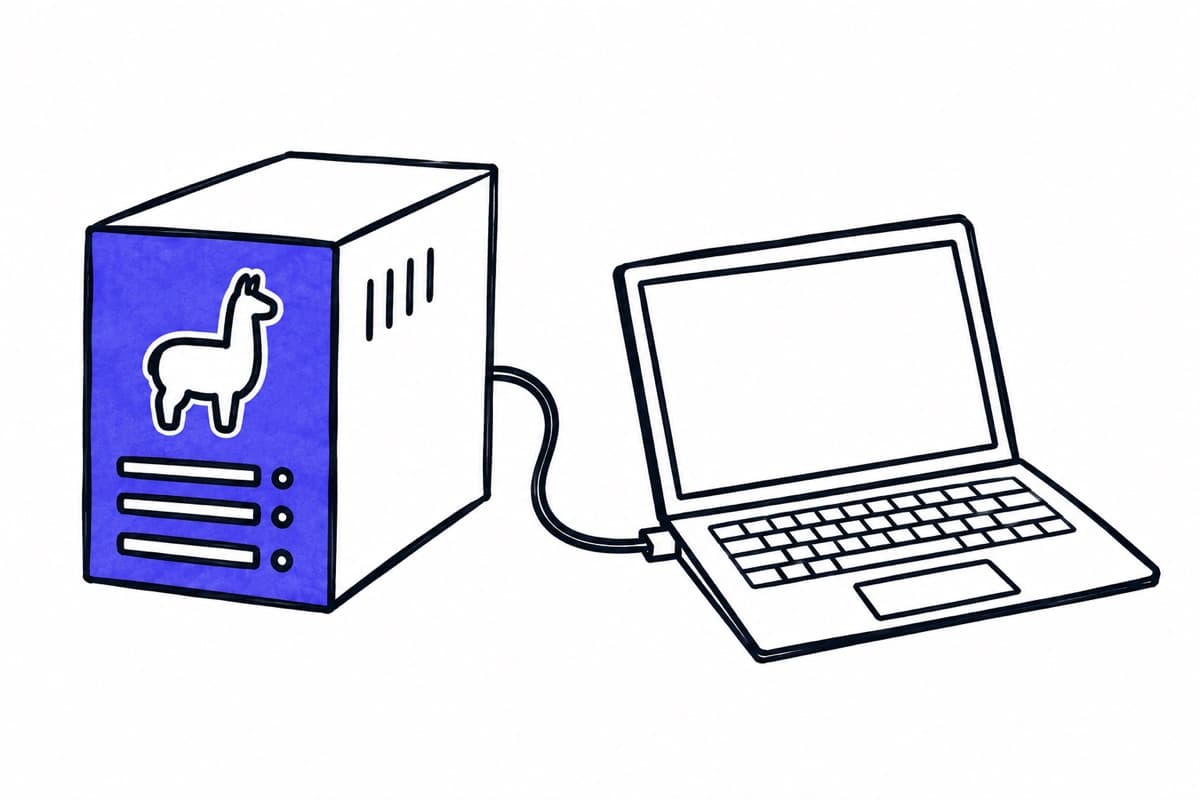
Our recommendation: plan. If you run open-weight models locally as agents with tools, block outbound internet access by default and allow only the destinations a workflow needs. Log every tool call, and keep test environments separate from production. What else local operation involves is covered in Ollama for business: uses, limits and operation.
03 / 06
Gemini Notebook in the Gemini app: off by default in the EEA
What happened. On 23 October 2026, Google made Gemini Notebook available as a connected app in the Gemini app. Users can manage and query their notebooks from a Gemini chat. For administrators, the feature is on by default: it is available to users in a group or organizational unit where both Gemini Notebook and Gemini are on. For end users, it is on by default worldwide but off by default in the EEA; users switch it on in the Gemini app under Settings > Connected Apps. Google lists all Google Workspace customers, Workspace Individual subscribers and users with personal Google accounts. (Google: Take actions on your notebooks from Gemini Notebook directly in the Gemini app)
What it means for SMEs. In Austria and Germany, the connection is off by default; users can switch it on in the Gemini app. A user can only do that if the administrator has enabled both Gemini and Gemini Notebook for them.
Our recommendation: act. Decide in the Admin console for which groups Gemini Notebook should be on. Tell your employees which data may go into notebooks. A short set of rules is described in AI usage policy for SMEs: rules for a small team.
Got a workflow like this?
Tell me about it. Honest take and a rough price, usually within a day.
04 / 06
Google Vault: export Gemini conversations from Workspace
What happened. On 22 October 2026, Google announced that Google Vault can export Gemini in Workspace conversations from Gmail, Drive, Docs, Sheets, Slides and Meet. This covers conversations created while conversation history is on. Admins can filter by user accounts or organizational units of up to 5,000 users and by date range. The JSON export contains user prompts, AI responses, generated attachments, links to referenced Workspace files and citations. Retention rules and litigation holds for this data will follow in future releases, and Vault API support within 14 days of the UI rollout. Google lists Business Plus, Enterprise Standard and Plus, Enterprise Essentials Plus, Frontline Standard and Plus, Education Fundamentals, Standard and Plus, and the Vault add-on. (Google: Google Vault now supports filtered exports for Gemini in Workspace)
What it means for SMEs. Companies with one of these editions can export what employees asked Gemini and what it answered, for example for an internal investigation. Business Standard is not on the list.
Our recommendation: plan. Check in the Admin console for which organizational units Gemini in Workspace conversation history is on and how its deletion is set. Plan Vault retention rules for these conversations for when Google adds them.
05 / 06
Agent Skills move to the Linux Foundation
What happened. On 22 October 2026, Anthropic donated the Agent Skills standard to the Agentic AI Foundation, which operates under the Linux Foundation. The donation includes the name and logo, the GitHub organization and the agentskills.io domain. A skill is a folder with a SKILL.md file that teaches an agent a specific task. According to Anthropic, more than 70 agent platforms have integrated the standard, including ChatGPT, Cursor, GitHub Copilot and VS Code; 1 million skills have been published and nearly 280 million installed. Anthropic proposes a roadmap with versioned releases, a formal proposal process and security guidance for skill authors and installers. (Anthropic: Donating Agent Skills to the Agentic AI Foundation)
What it means for SMEs. The shared format may make some work instructions easier to reuse across tools that support it. Compatibility still needs testing: a shared format does not mean that every skill works the same way in every tool.
Our recommendation: watch. If you document internal processes for AI assistants, consider the skill format. Before you install skills from third parties, check what they do, as you would with any software. How tool access for agents works is explained in MCP servers for companies: what they are and what they may do.
06 / 06
In brief: the other providers
| Provider | What is confirmed | Relevance for SMEs |
|---|---|---|
| OpenAI | The Decisions API is generally available with gpt-6-luna since 22 October. A request can contain up to 400 questions instead of 200 in the beta, and eligible reused shared inputs can receive prompt-cache discounts (API changelog) |
Watch: for developers with many repeated classification decisions |
| OpenAI | ChatGPT Business owners and admins can manage members and available workspace controls in the Admin Console since 21 October; existing roles and plan permissions still apply (ChatGPT Business release notes) | Watch |
| Docs Live, which creates structured documents from speech, is available in the Google Docs apps for Android and iOS since 21 October for eligible users, including Business Standard and Plus and Enterprise Standard and Plus (Docs Live on mobile) | Watch: check availability for your users in Austria or Germany | |
| On 21 October, Google described a Customize menu in the Gemini app that brings skills and connected apps together; its worldwide rollout started on 13 October. According to Google, most connected apps are available in English in the US, with select apps also in other regions (An easier way to customize how Gemini works for you) | Watch | |
| AWS | The web search tool in Amazon Bedrock supports up to 100 allowed or up to 100 blocked domains and a user location since 23 October. AWS lists only US regions for this feature (Web Search on Amazon Bedrock now supports domain filtering and user location controls) | Watch |
| Make | Claude Haiku 5.5 can be used in Make AI Toolkit, the Anthropic Claude app and Make AI Agents; Make listed the announcement on 23 October (Claude Haiku 5.5 is available in Make, Make releases 2026) | Watch |
| Mistral | Z.ai's GLM 5.3 Flash is available on Mistral's platform since 22 October with a 1M-token context window, at 0.15 US dollars input, 0.03 cached input and 0.50 output per million tokens (Mistral changelog) | Watch |
| Cohere | Rerank 5 Pro and Rerank 5 Fast reorder retrieved documents by relevance since 21 October; the optional Context Focus returns the relevant passages (Cohere Release Notes). Background: Improve RAG retrieval with hybrid search and reranking | Watch: for search over internal documents |
| Mistral | Voxtral 3, published on 20 October after our last issue: four speech models for speech-to-text and text-to-speech, all in public preview, through Mistral's EU-hosted API or self-deployment (Voxtral 3, changelog) | Watch: for phone assistants and transcription |
We also checked Meta, Aleph Alpha, DeepSeek, n8n and Zapier as well as the European Commission and the AI Office, the RTR KI-Servicestelle, the Bundesnetzagentur and the data protection authorities in Austria and Germany, and selected no item from them for this issue. Left out on purpose: benchmark claims, stock market listings and funding news.
If you want to know what one of these changes means for your existing workflows, we are happy to talk it through in an AI consulting call.