Design the connection and information handover together. The caller should understand what is happening, and the recipient should know why the call is arriving. This guide describes proposed processes and acceptance checks, not guaranteed behaviour from a particular product.
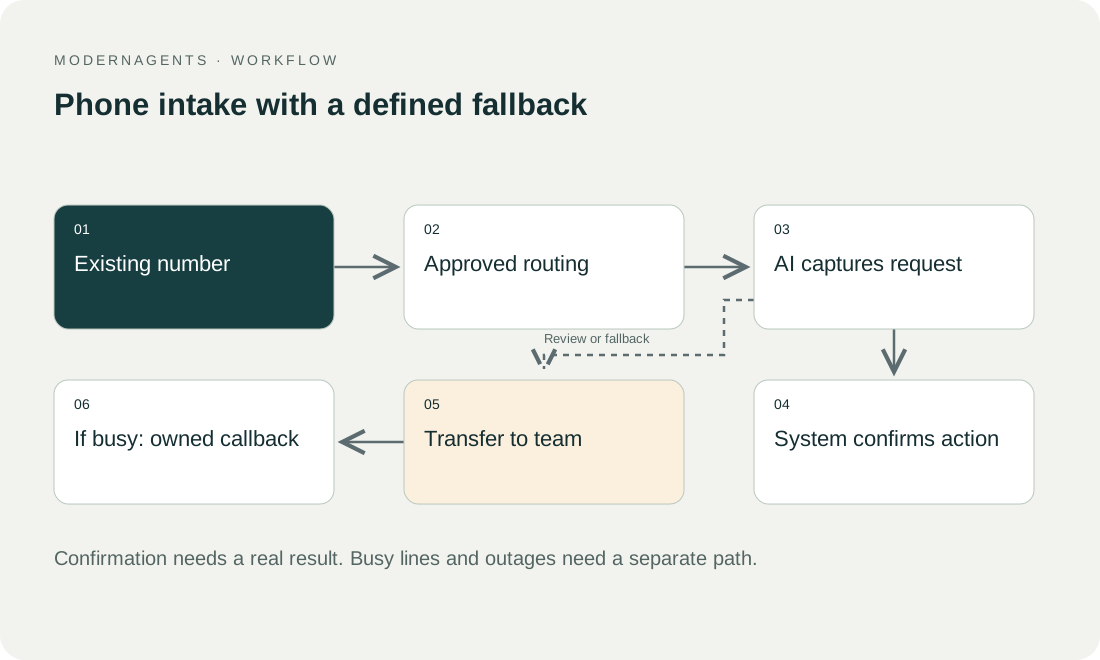
The diagram separates a bounded automated task from a human route. To implement it, replace abstract destinations with actual telephone numbers, operating hours and responsible teams. Every branch needs an observable result.
Key takeaways
The main points for human handover from an AI phone assistant are:
- The article distinguishes four forms of handover: direct transfer, announced transfer, callback task and scheduled callback.
- A technically answered call may reach voicemail, so define successful handover in operational terms as well as telephone states.
- Before approval, test an answered call, busy destination, no answer, voicemail, closed department, missing callback number and failed task delivery.
01 / 09
When should a person take over the call?
Set the triggers before entering destination numbers. Typical triggers for a human handover include:
- an explicit request for a person
- repeated misunderstanding
- an unauthorised decision
- a professionally defined escalation
The assistant should not delay a request for human help through an endless sequence of sales or clarification questions.
Destinations. Different triggers may have different destinations. An invoice question may go to finance, a delayed delivery to customer service and a complex quotation to sales. Describe destinations by purpose and restrict them to approved contacts. A caller's free-text instructions should not become permission to dial arbitrary external numbers.
Escalation or technical failure. Separate operational escalation from technical failure. An unavailable CRM does not make every call urgent. Conversely, a critical report must not disappear into an ordinary integration-error queue merely because an application is unavailable at the same time.
02 / 09
Which form of handover fits?
The table compares four forms of handover from an AI phone assistant by process, suitable situation and the most important test.
| Form | Process | Useful when | Important test |
|---|---|---|---|
| Direct transfer | Connect the caller to a destination | Context is simple or available separately | Busy and unanswered calls |
| Announced transfer | Give the recipient context before connecting | A more complex issue needs explanation | Who hears which information? |
| Callback task | End the call with an owned work item | Staff are unavailable now | Ownership and a realistic timeframe |
| Scheduled callback | Agree a reserved callback slot | Capacity can actually be allocated | Confirmed booking versus preference |
Products can implement a “warm transfer” differently. Ask for the exact sequence: Is the employee called first? Does the caller remain connected? Who hears the summary? What happens if the employee declines? Those details need to appear in the acceptance test.
Consider the recipient's environment too. Someone answering a mobile phone may not have access to the CRM screen that accompanies an office call. The handover design should match the devices and working conditions of the people expected to accept it.
03 / 09
Does a connected call mean a successful handover?
Call states. Telephone platforms expose several call states. Twilio's Dial documentation, for example, describes time limits and results from an attempted connection. These events can drive application logic, but they do not automatically establish that the correct person understood the issue.
Voicemail and short connections. A technically answered call may reach voicemail. A completed connection may last only a moment. Define successful handover in operational terms as well as telephone states. Important processes may benefit from an explicit recipient acceptance or a confirmed work-item acknowledgement.
Provider evidence. Ask the provider to show the information it actually exposes. Do not assume it can distinguish voicemail from a person unless that behaviour has been demonstrated on your route. A straightforward, well-managed callback process may suit the business better than a complicated transfer with an unclear outcome.
04 / 09
Worked example: the service team is busy
Situation. A customer reports a delayed delivery and asks for service. The assistant collects the order reference and confirms whether the incoming number is suitable for a callback. It announces the attempted connection, but the service destination is busy.
Approved rule. The approved rule is to return to the caller after a bounded attempt, explain that no one was reached and create a callback task. The customer does not hear a success claim. The record contains the order reference, reported problem, confirmed number, failed connection attempt and responsible service queue.
Callback deadline. A callback deadline is communicated only if it comes from a valid operating rule. If service is closed, the assistant should not invent a promise of help “in a few minutes”. It can explain the next staffed period or offer an approved alternative.
Task creation disabled. For an important exception, test the same scenario with task creation disabled as well. The design must explain what happens when neither live transfer nor normal task delivery works. A monitored secondary route is needed if the business still intends to promise that the message has been accepted.
Got a workflow like this?
Tell me about it. Honest take and a rough price, usually within a day.
05 / 09
What context does the recipient need?
A useful handover contains the reason for calling, confirmed facts, unresolved questions and the requested next action. The recipient does not necessarily need the whole transcript. Long notes can hide critical information and spread unnecessary personal data.
Distinguish statements from verified facts. “Caller says the invoice was paid yesterday” differs from “invoice paid”. Likewise, “requests a callback before 15:00” must not become an accepted service deadline unless someone has authorised that commitment.
Check when context becomes available. If a summary arrives by email only after the conversation ends, it is retrospective documentation rather than support for the live handover. Where a CRM record opens automatically, verify that it is the correct record and that the recipient is entitled to see it.
06 / 09
How do you prevent loops, outages and duplicate tasks?
Loops. Draw the complete route. A common planning problem is a human destination that forwards unanswered calls back to the public main number. If that number leads to the assistant, the call can loop. The fallback must explicitly avoid returning to the same path indefinitely.
Duplicate tasks. Repeated delivery of a technical event should not create several callback tasks. Use a stable conversation or work-item identifier and check whether the destination already holds the item. Where the result is uncertain, reconcile the state before repeating a write.
Complete outage. For a complete assistant outage, provide a telephone route that does not depend on the assistant's conversational logic. A fallback rule inside the same unavailable service cannot solve every outage. Agree who activates the alternative and how it is implemented with the telephone provider.
07 / 09
How do you measure handover in operation?
Track offered transfers, accepted connections, callback tasks created and callbacks completed separately. State the denominator for every rate. Otherwise, fewer transfers can look like progress even when more callers abandon the call before reaching that stage.
Review short connections, repeated transfer attempts and overdue callbacks. Compare the telephone events with the destination system. The central question is whether the caller received a usable next step and whether someone accepted responsibility for it.
Acceptance cases before approval
Before approval, test these handover cases:
- an answered call
- a busy destination
- no answer
- voicemail
- a closed department
- a missing callback number
- failed task delivery
Document the permitted ending for each case. That makes human handover an observable process with accountable outcomes.
08 / 09
Take the worksheet
Worksheet
Download the editable CSV table
| State | Next step | Evidence of success |
|---|---|---|
| Staff available | Transfer with brief context | Person actually accepts |
| Staff busy | Offer callback | Confirmed number and owned queue |
| Outside opening hours | State realistic response window | No immediate-service promise |
| Caller disconnects | Preserve available information | Incomplete task clearly marked |
| Task system unavailable | Approved alternative contact route | No false completion claim |
Columns to fill in, in the file: Your value / observation, Owner, Next action.
Download the editable CSV table (CSV). Add your own values, owners and open actions. This worksheet contains no measured client results.
09 / 09
Related decisions
These pages cover the service overview and the related decisions for human handover from an AI phone assistant:
- AI phone assistants: functions and boundaries
- Use an AI phone assistant with your existing number
- Measure AI phone assistant quality in operation
- Customer-service AI chatbots: plan the human handover
For a workflow review, start with the task, systems involved and typical exceptions. Discuss it with modernagents.