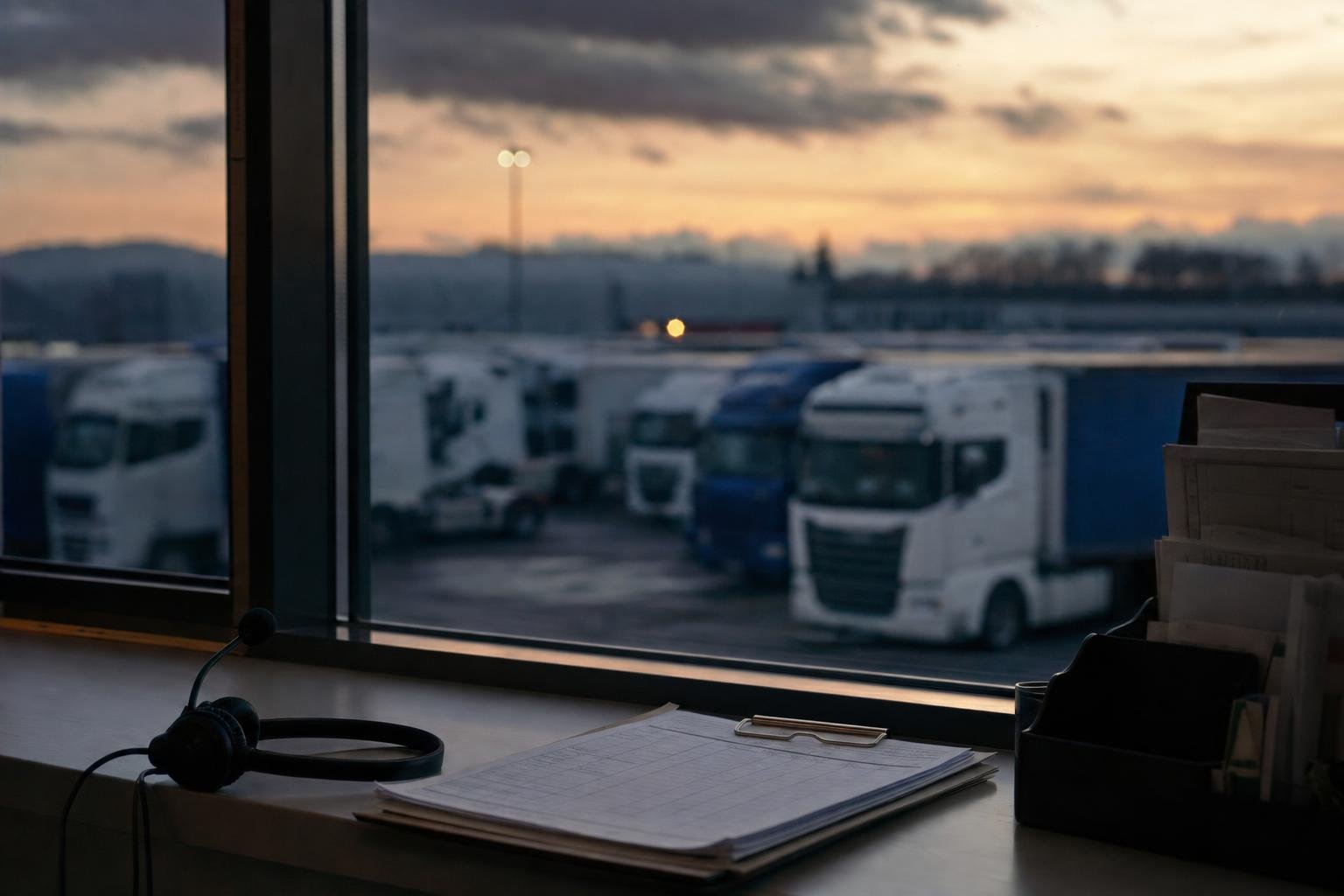
The federal statistics office's March 2026 numbers read brutally for the industry: transport and warehousing, which covers road freight but also passenger transport, warehousing and courier services, recorded 133 insolvencies per 10,000 companies in 2025, the highest rate of any sector, ahead of hospitality and construction. Creditreform's 2026 default study confirms the picture with different methodology: transport and logistics leads there too, at 3.58 percent. And the buffers are thin: operating margins in road freight sit mostly between 1 and 3 percent per the federal market monitor.
Meanwhile staff is missing at both ends. Eleven industry associations, including BGL and DSLV, put the driver gap at over 70,000 in their January 2026 joint paper, with a structural deficit of roughly 15,000 a year as 30,000 to 35,000 retirements meet only 15,000 to 20,000 new entrants. BGL board spokesman Engelhardt separately says "120,000 plus X"; the two figures come from different methods and should not be blended. The circulating "100,000 missing drivers" is a 2023 campaign figure, and Austria's "8,000 missing drivers" dates from September 2021; whoever sells you those as current has not checked. Less known than the driver shortage is the second bottleneck: forwarding and logistics clerks have been an official shortage occupation since 2023, and new apprenticeship contracts fell almost 9 percent in 2024. The dispatch office holds the operation together, and that is exactly where the people are running out.
The paper reality behind the digital rhetoric
Per the EU Commission, paper is still involved in 99 percent of cross-border transports. The last solid survey on the digital consignment note (Bitkom, 2022) found 77 percent using it at least partially, but only 5 percent exclusively. Yet the legal road has long been clear: the eCMR protocol has been in force for Germany since April 2022 and for Austria since November 2024, it just remains voluntary and requires the parties' agreement. The eFTI regulation obliges authorities to accept electronic freight information from July 2027; it never obliges companies. Whoever waits for the big mandatory deadline waits forever; the advantage belongs to those who kill the paper flow out of self-interest.
Where the software vendors slept
The order of AI shipments tells the real story: the freight exchange Timocom shipped its AI freight entry in December 2024, Transporeon followed in September 2025 with AI transport planning, aimed more at shippers and large carriers. The classic SME transport-management systems only caught up in 2026; LIS announced AI order entry for WinSped in January 2026 for the LogiMAT fair, and for CargoSoft no shipped AI product was findable by mid-2026. Into that gap grew a whole niche of TMS-agnostic German vendors for the email-to-order pipeline. Which confirms the core point: the automatable layer sits between the inbox and the TMS, not inside the TMS.
What works there concretely, with human sign-off as the default:
- Order capture from email and PDF: transport orders arrive as attachments in twenty formats and get retyped. A capture system reads, structures and hands over to the TMS as a proposal; one forwarder handling around 350 orders a day reports about two thirds less capture effort in a vendor case study, a number to be labeled as such, but directionally plausible.
- Document flow: proof-of-delivery, consignment notes and customs papers recognized, matched to the order, filed ready for billing. That is also the groundwork for the e-invoicing duty, since freight invoices with their many surcharge lines must be issued in structured form from 2027/2028.
- Waiting-time documentation: detention claims often fail on evidence because ramps refuse to countersign; drivers keep paper logs. Timestamps from telematics and driver apps, bundled automatically into a protocol, turn the paper chase into a claim with a file.
- Freight-invoice checking: for the circulating error rates no serious source exists; for the error categories they do: outdated diesel floaters, wrong weight classes, flat-rate instead of per-kilometer tolls. A checking system reconciles invoice against agreement and puts deviations in front of a person.
The guardrails, named honestly
Two limits belong in every conversation. First, driver data: covert or permanent GPS tracking has been struck down by a German court, and Austria's supreme court requires a works agreement or consent. Telematics automation is built with the works council, not around it. Second, the AI Act: dispatching that assigns tours based on individual driver behavior or scores drivers plausibly falls under the high-risk category for worker management, whose obligations bite from December 2027; pure route and load optimization rather not. Our position is simple: we automate the paperwork, not the scoring of people. And customer-facing assistants will say they are machines from 2 August 2026 anyway.
At 1 to 3 percent margin the math is plain: every dispatcher hour that does not go into retyping is worth disproportionately much, and the people who do it are demonstrably not reorderable. Whether your forwarding business has an automation case, the 60-second check will indicate; what projects cost is in the pricing overview, with sources, and how sign-offs work with us in draft plus sign-off.
As of 10 July 2026, not legal advice. Sources: Destatis PD26_085 (March 2026), Creditreform default study 2026, federal market monitor (BAG) on margins, eleven-association driver-shortage paper (January 2026), BGL/eurotransport (January 2026), federal employment agency shortage analysis, BIBB apprenticeship statistics 2023/2024, Bitkom digital consignment note (2022), EU Commission on eFTI, UN treaty status eCMR (DE 2022, AT 2024), VG Wiesbaden 6 K 1164/21.WI, Austrian OGH 9 ObA 120/19s, EU AI Act Annex III and Art. 50 (post Digital Omnibus), vendor announcements Timocom/Transporeon/LIS/CargoSoft, Austrian WKO trade statistics (May 2026).